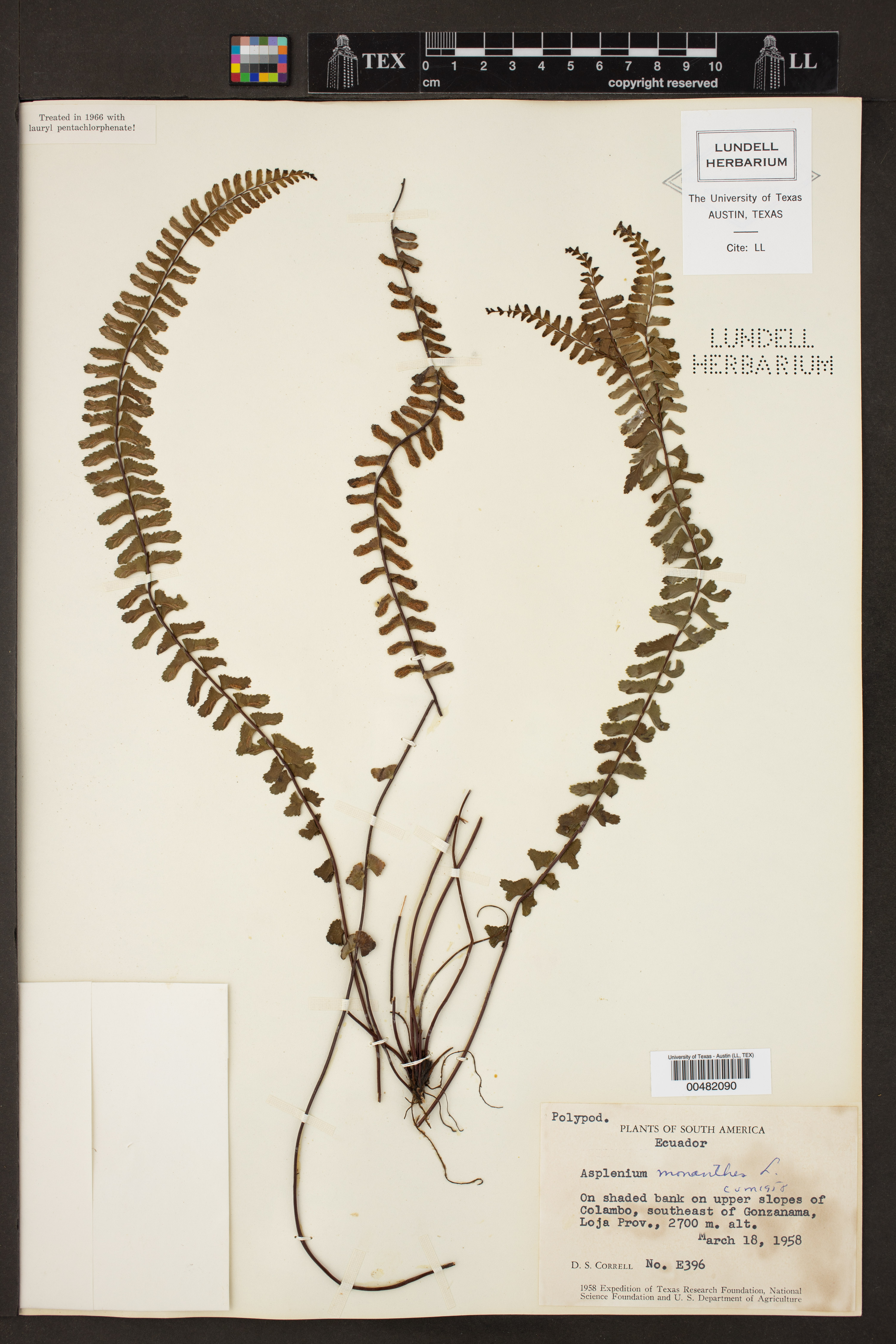
Asplenium monanthes, the single-sorus spleenwort, is a fern native to parts of Africa, islands in the Atlantic, the Americas and Hawaii. It belongs to the family Aspleniaceae.
Description
Here are key features of Asplenium monanthes:
The erect-standing leaves' rachises are reddish dark-brown/blackish throughout, shiny and hairless.
The once pinnately-divided leaves usually are up to 60 cm (24 in) long, but mostly about half that, and up to around 3 cm (1 in) wide. The leaves' 10-45 pairs of subdivisions, or pinnae, are strongly asymmetric, somewhat trapezoidal, the leaf's middle ones up to
A single sorus (rarely up to 3) occurs on each fertile pinna, always near the lower, toothless margin. Sori are slender to oval in outline, with a narrow, silvery scale or film of tissue, the "indusium," running along the pinna's lower margin. When the spore-producing sporangia are mature, they may hide the indusium.
At some locations the above details still may not be enough to distinguish Asplenium monanthes from similar species in the area. An obscure feature possibly helping to confirm the identity is that sometimes along the length of the rachis, two very narrow, silvery, filmy "wings" can be observed, especially with magnification; these are barely visible in images on this page. Also, these filmy wings' margins do not bear tiny, pimple-like bumps, but rather are entire or slightly notched.
Distribution
Asplenium monanthes displays a scattered distribution. In the United States, it occurs in the southern states of Arizona, North and South Carolina, Alabama and Florida, plus Hawaii. In the Caribbean, it inhabits the islands of Jamaica and Hispaniola. In Mexico it occurs nearly throughout, though not in the Yucatan Peninsula. In Central America, it is found in Guatemala, El Salvador, Honduras, Nicaragua, Costa Rica and Panama. In South America, it inhabits Colombia, Venezuela, Ecuador, Peru, Bolivia, Brazil, Uruguay and Argentina. In Africa, it is found in...