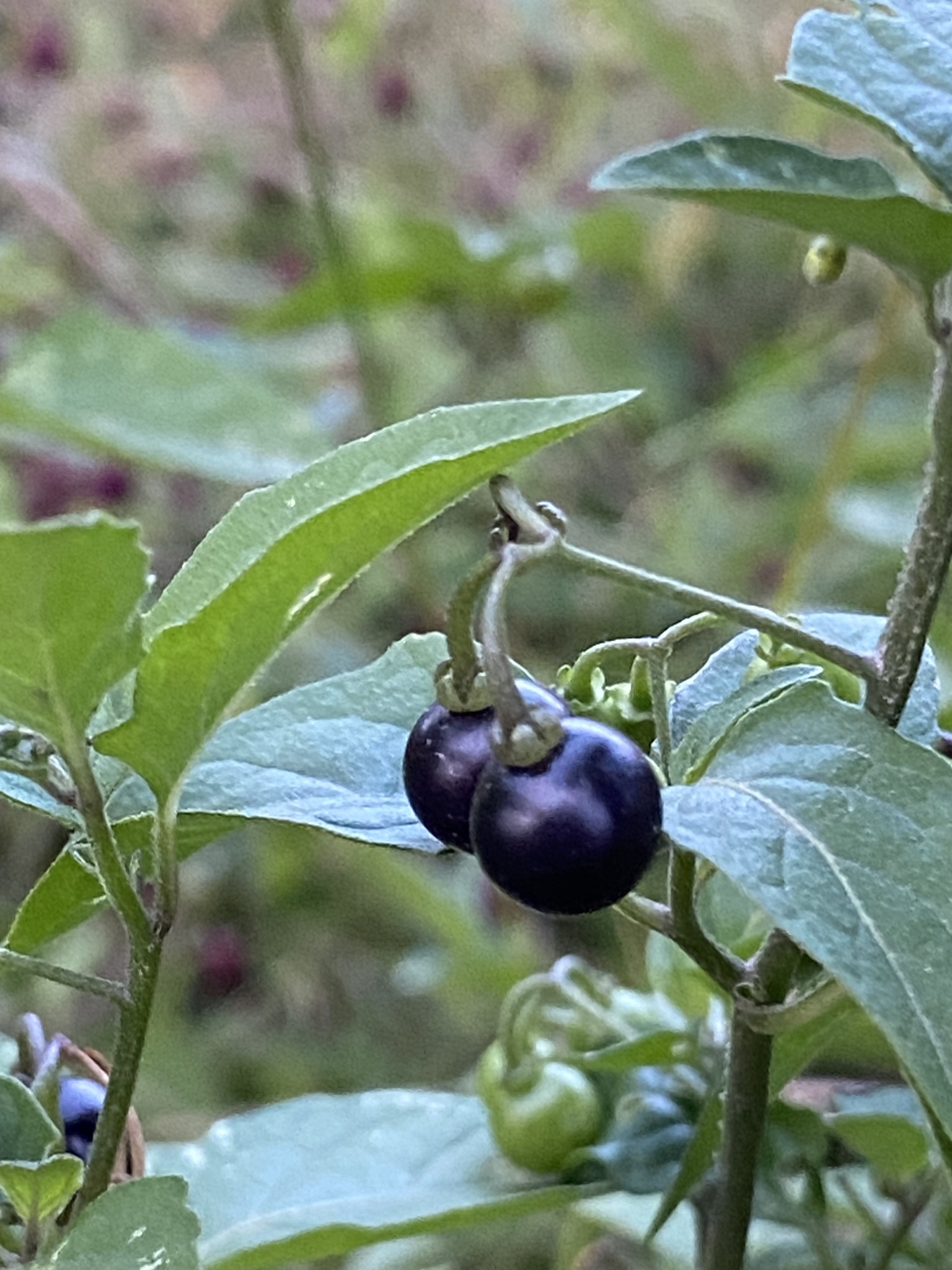
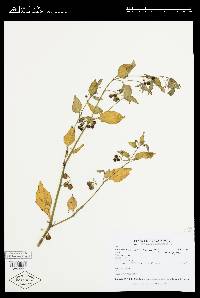
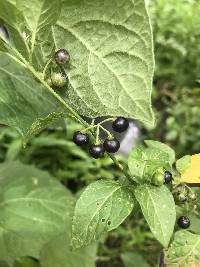
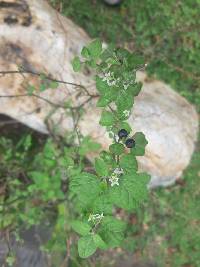
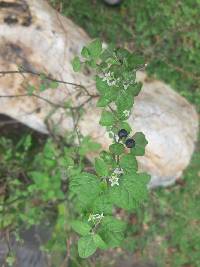
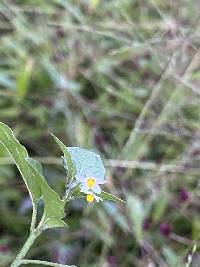
Solanum americanum, commonly known as American black nightshade, small-flowered nightshade or glossy nightshade, is a herbaceous flowering plant.
Description
Solanum americanum grows up to 1–1.5 metres (39–59 in) tall and is an annual or short-lived perennial. The leaves are alternate on the branch, and vary greatly in size, up to 10 centimetres (4 in) long and 7 cm (3 in) broad, with a
Taxonomy
Solanum americanum is one of the most widespread and morphologically variable species belonging to the section Solanum. It can be confused with other black nightshade species in the Solanum nigrum complex.
Solanum americanum is a variable taxon. It is considered by some botanists to be more than one species, and others recognise subspecies. Some botanists have suggested that S. americanum may be conspecific with the European nightshade, S. nigrum.
Solanum ptychanthum (eastern black nightshade) has historically been distinguished from S. americanum by differences in its berries and the underside of seedling leaves. However, more recent taxonomies treat them as a single species because of the wide variation in S. americanum.
Distribution and habitat
It has a wide but uncertain native range. The certain native range encompasses the tropics and subtropics of the Americas, Melanesia, New Guinea, and Australia. The plant is widely naturalised around the tropical Pacific and Indian Oceans, including Hawaiʻi, Indochina, Madagascar and Africa, possibly via anthropogenic introduction in these locales.
Toxicity
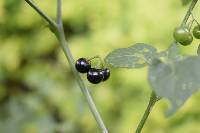
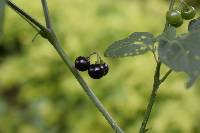
S. americanum berries
Research indicates the presence of toxic glycoalkaloids, with authorities warning to be careful regarding the use of S. americanum as herbal medicine or food. The green fruit is particularly poisonous and eating unripe berries has caused the death of children. Ripe berries and foliage may also cause poisoning, though the toxicity seems to diminish somewhat with ripening. This is due to high levels of the glycoalkaloids,...