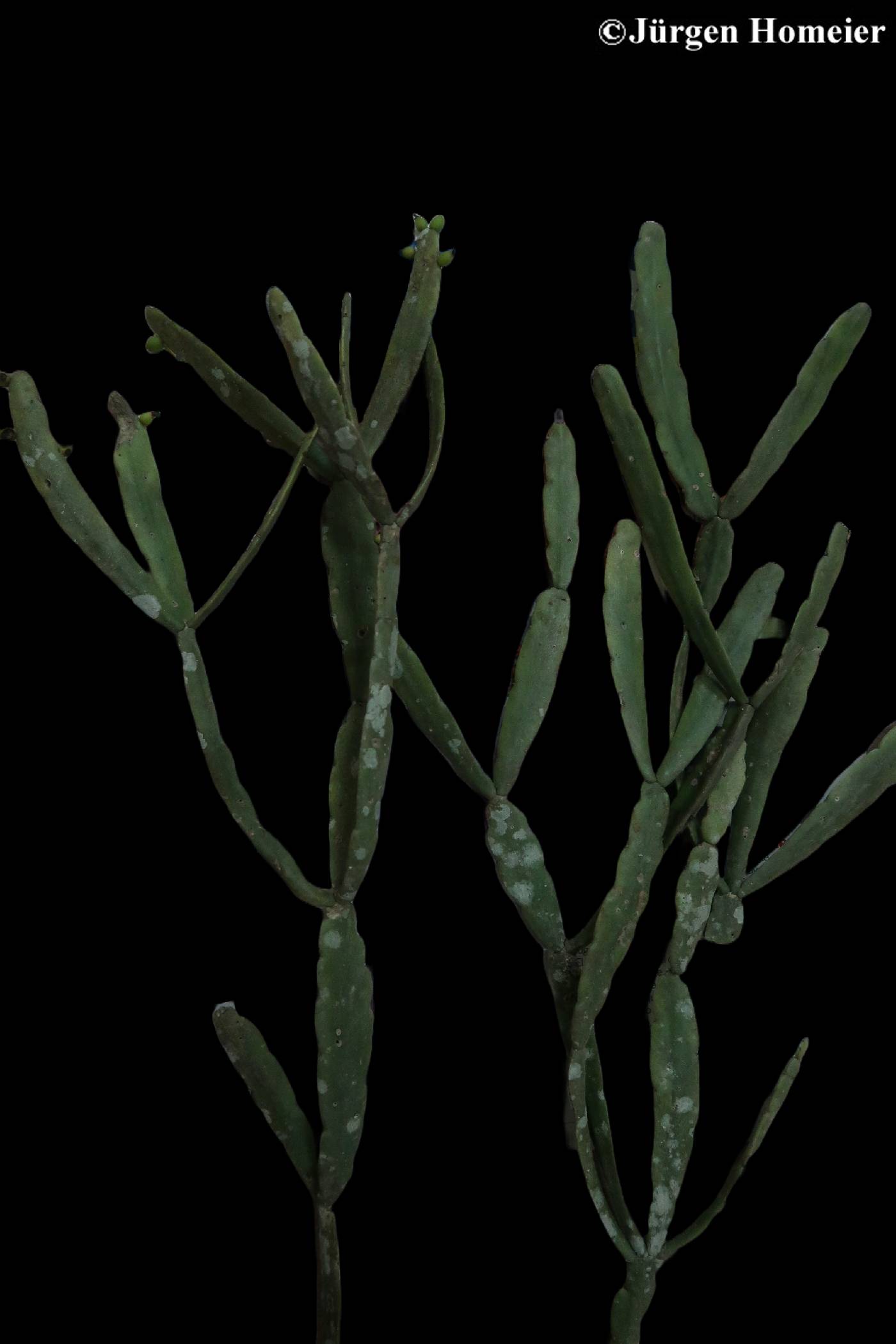
Rhipsalis ( RIP-suh-lis) is a genus of epiphytic flowering plants in the cactus family, typically known as mistletoe cacti. They are found in parts of Central America, the Caribbean and northern regions of South America. One species, Rhipsalis baccifera also inhabits locations in Africa and Asia, and is the only cactus species naturally occurring in the Old World. This is the largest and most widely distributed genus of epiphytic cacti (those which live on other plants without damaging them).
The scientific name Rhipsalis derives from the Ancient Greek term for wickerwork, referring to the plants' many entangled or intertwined branches.
Description
The morphology of Rhipsalis is very variable. The plants can grow mostly pendent, few grow more or less upright or sprawling. There are three main stem shapes: terete, angular and flattened. The stems are succulent, but the degree of succulence varies between the species. Some have very thick stems (e.g. Rhipsalis neves-armondii), whereas other have very thin, filiform stems (e.g. Rhipsalis baccifera, Rhipsalis clavata). In the majority of species, spines are missing or occur only in the juvenile stage (this is most prominent in Rhipsalis dissimilis). Rhipsalis pilocarpa has stems and fruits densely covered by bristles, making this species easily distinguishable from all other Rhipsalis.
The flowers are borne lateral or apical and are actinomorphic with a varying number of perianth segments, stamens and carpels. They are small, usually about 1 cm in diameter, white or whitish in most species. Yellowish flowers occur in R. dissimilis and R. elliptica and R. hoelleri is the only Rhipsalis species with red flowers. The fruits are always berries, they are whitish or coloured pink, red or yellow. Vivipary has been observed in R. micrantha and R. baccifera.
Taxonomy
The genus was described by Joseph Gaertner in 1788. But when he described the plant, he had in fact not realised it was a cactus. Instead, he assumed he had found a new...