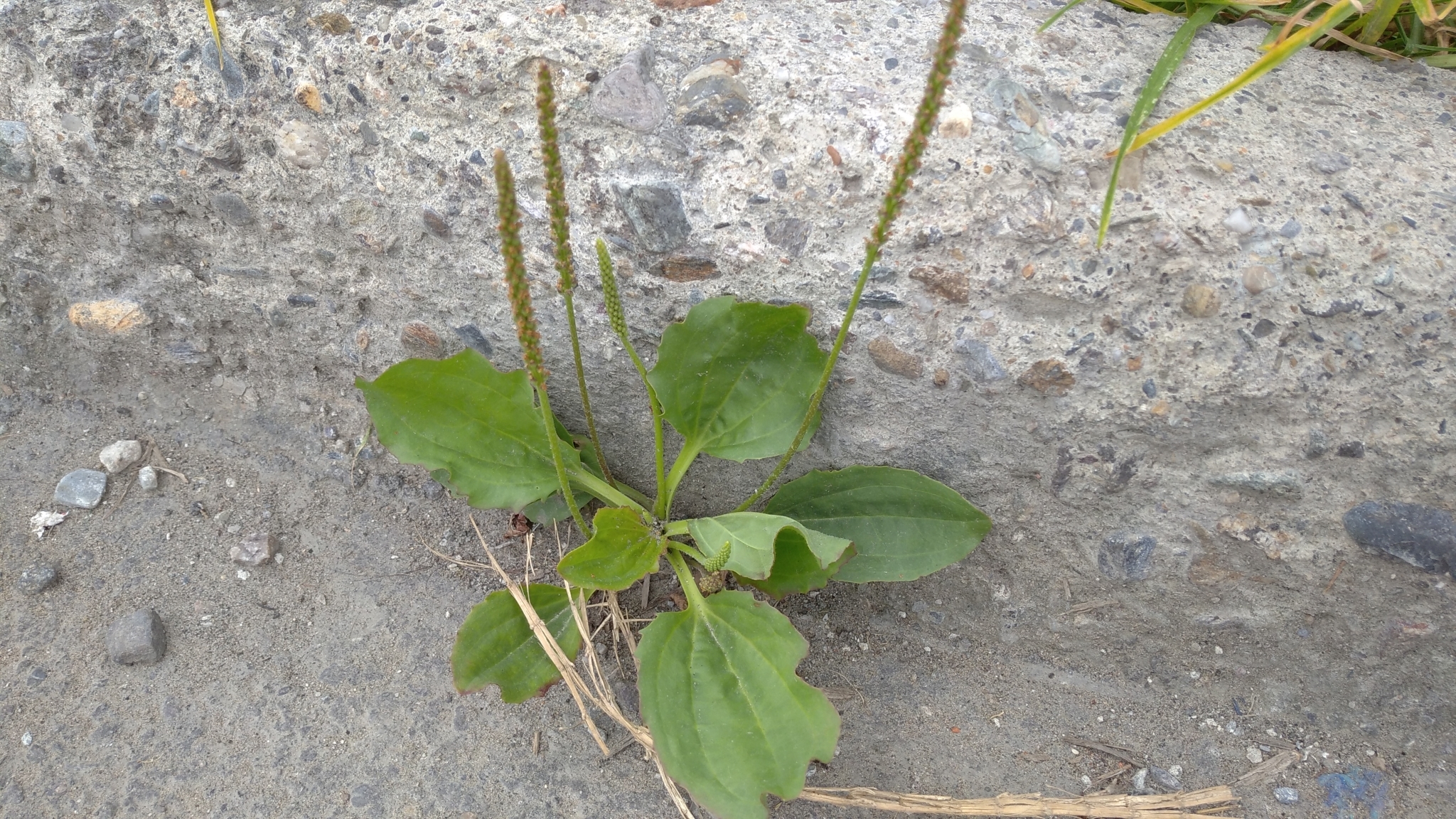
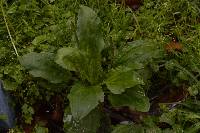
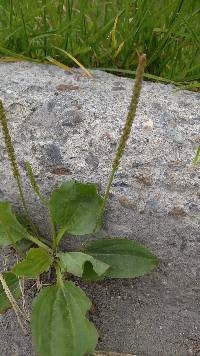
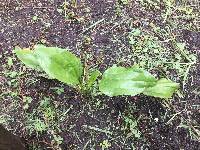
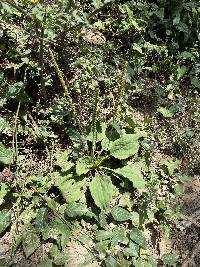
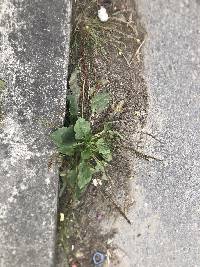
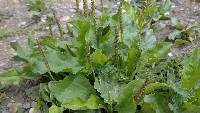
Plantago major, the greater plantain, is a species of flowering plant in the plantain family Plantaginaceae. It is native to Eurasia and temperate Africa, and widely naturalised elsewhere.
Greater plantain is not closely related to the fruit also known as plantain, which is a type of banana.
Description
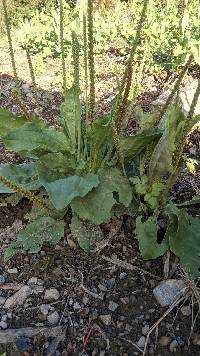
Plantago major is a herbaceous, perennial plant with a rosette of leaves 15–30 centimetres (6–12 inches), exceptionally 70 centimetres (28 inches), in diameter. Each leaf is oval-shaped, 3–18 cm (1–7 in) long and
Greater plantain is wind-pollinated and propagates primarily by seeds, which are held on the long, narrow spikes which rise well above the foliage. Each plant can produce up to 20,000 seeds, which are very small and oval-shaped, with a bitter taste.
Taxonomy
There are three subspecies:
Plantago major subsp. major. Occurs throughout the range of the species.
Plantago major subsp. intermedia (Gilib.) Lange. Occurs in Europe, northwest Africa, and northern Asia, but its distribution is not well studied; it grows in wetter habitats, including saline locations such as saltmarshes and beside salted roads. It differs in having finely hairy, narrower, 3–5-veined leaves.
Plantago major subsp. winteri (Wirtg.) W.Ludw. Occurs in central and northeastern Europe.
Distribution and habitat
Greater plantain is native to almost all of Europe (Iceland excepted), northern and central Asia, and northern and southern Africa. and has become widely naturalised elsewhere in the world.
The ability of greater plantain to survive frequent trampling and colonise compacted soils makes it important for soil rehabilitation. Its roots break up hardpan surfaces, while simultaneously holding together the soil to prevent erosion. The seeds are a common contaminant in cereal grain and other crop seeds. As a result, it now has a nearly worldwide distribution. Plantago major grows in lawns and fields, along roadsides, and in other areas that have been disturbed by humans. It does...