Phytolacca is a genus of perennial plants native to North America, South America and East Asia. Some members of the genus are known as pokeweeds or similar names such as pokebush, pokeberry, pokeroot or poke sallet. Other names for species of Phytolacca include inkberry and ombú. The generic name is derived from the Greek word φυτόν (phyton), meaning "plant," and the Latin word lacca, a red dye. Phytolaccatoxin and phytolaccagenin are present (in the leaves, stems, roots, blossoms, berries etc.) in many species which are poisonous to mammals if not prepared properly. The berries are eaten by birds, which are not affected by the toxin. The small seeds with very hard outer shells remain intact in the digestive system and are eliminated whole.
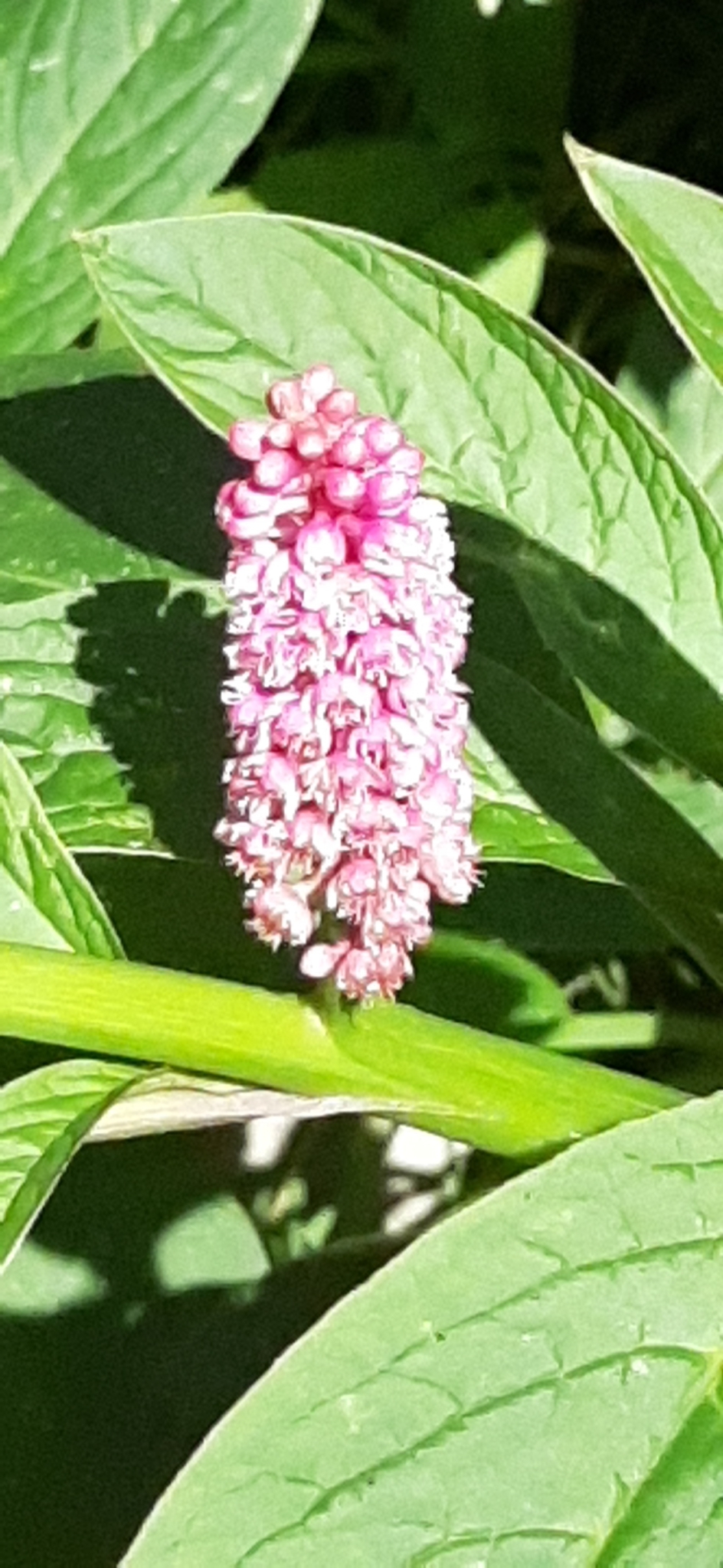
The genus comprises about 25 to 35 species of perennial herbs, shrubs, and trees growing from 1 to 25 m (3 to 80 ft) tall. They have alternate simple leaves, pointed at the end, with entire or crinkled margins; the leaves can be either deciduous or evergreen. The stems are green, pink or red. The flowers are greenish-white to pink, produced in long racemes at the ends of the stems. They develop into globose berries 4 to 12 millimetres (0.2 to 0.5 in) diameter, green at first, ripening dark purple to black.
Selected species
Although many species are herbaceous, P. dioica forms a substantial tree
Nymboida National Park, NSW, Australia, August 2014.
The following species are accepted by one or more regional floras:
Phytolacca acinosa Roxb. – Indian poke. Southern and eastern Asia (syn. P. esculenta Van Houtte, P. latbenia (Moq.) Walter). Black and Judziewicz report it in Dane County, Wisconsin in their 2008 and 2009 books (Wildflowers of Wisconsin and the Great Lakes Region. A Comprehensive Field Guide, first and 2nd editions. )
Phytolacca americana L. – American pokeweed. North America (syn. P. decandra L.)
Phytolacca australis Phil. – Western South America
Phytolacca bogotensis Kunth – Tropical and subtropical South America...