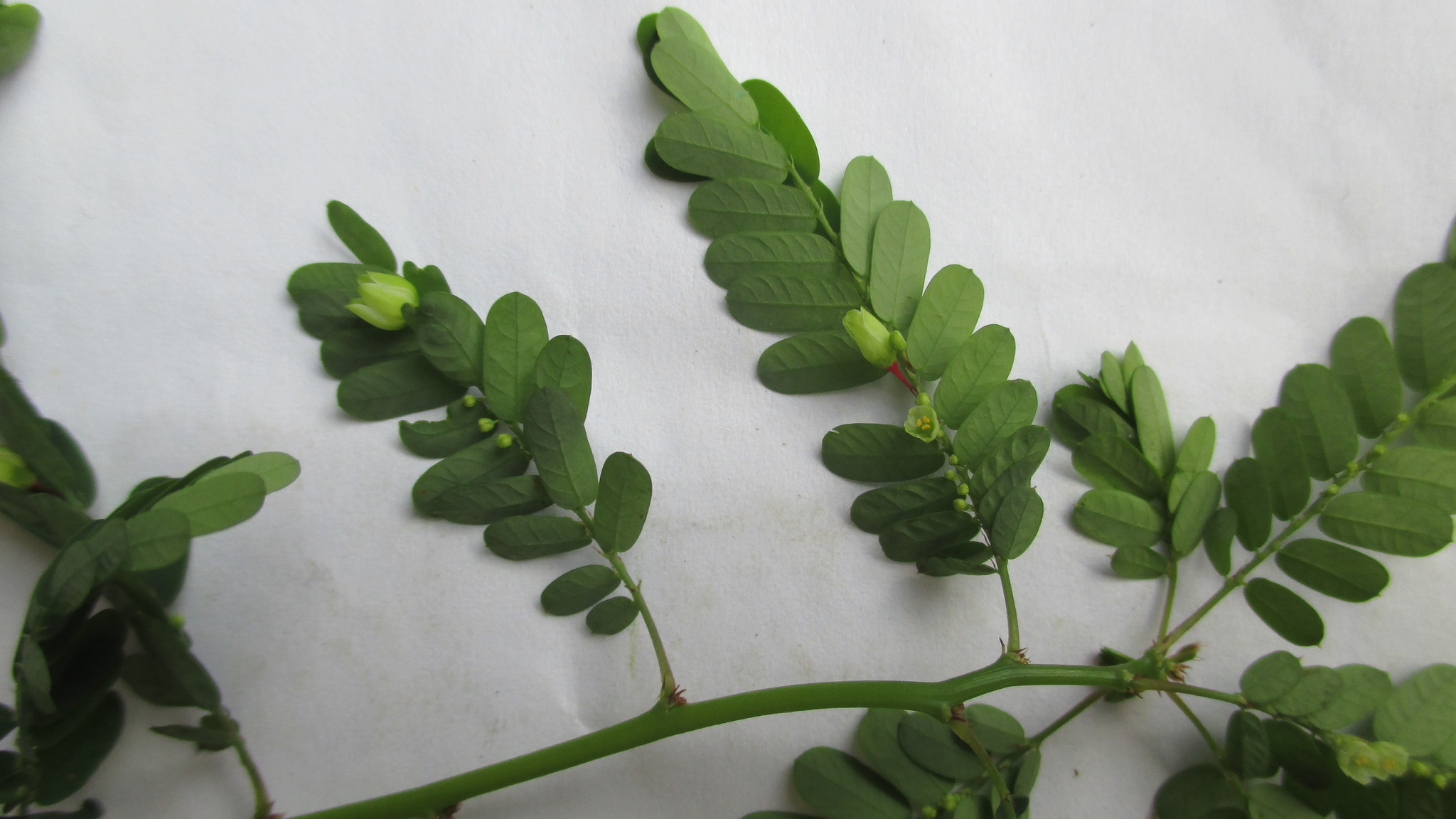
Phyllanthus is the largest genus in the plant family Phyllanthaceae. Estimates of the number of species in this genus vary widely, from 750 to 1200. Phyllanthus has a remarkable diversity of growth forms including annual and perennial herbs, shrubs, climbers, floating aquatics, and pachycaulous succulents. Some have flattened leaflike stems called cladodes. It has a wide variety of floral morphologies and chromosome numbers and has one of the widest range of pollen types of any seed plant genus.
Despite their variety, almost all Phyllanthus species express a specific type of growth called "phyllanthoid branching" in which the vertical stems bear deciduous, floriferous (flower-bearing), plagiotropic (horizontal or oblique) stems. The leaves on the main (vertical) axes are reduced to scales called "cataphylls", while leaves on the other axes develop normally. Phyllanthus is distributed in all tropical and subtropical regions on Earth.
Phyllanthus was first described by Carl Linnaeus in 1753; the type species has subsequently been designated as Phyllanthus niruri.
Taxonomy
The circumscription of this genus has been a cause of much confusion and disagreement. Molecular phylogenetic studies have shown that Phyllanthus is paraphyletic over Reverchonia, Glochidion, Sauropus, and Breynia. A 2006 revision of the family Phyllanthaceae has subsumed all four of these genera into Phyllanthus. This enlarged version of Phyllanthus might eventually be divided into smaller genera, including 32 Chinese (and northern Indochinese) species. A complete overhaul of the genus, including a new classification was underway in the 2020s, following an in-depth molecular treatment of major groups included. Proposed new genera are Breynia, Cathetus, Cicca, Dendrophyllanthus, Emblica, Flueggea, Glochidion, Heterosavia, Kirganelia, Lingelsheimia, Lysiandra, Margaritaria, Moeroris, Nellica, Nymphanthus, Phyllanthus (s.s.), Plagiocladus and Synostemon.