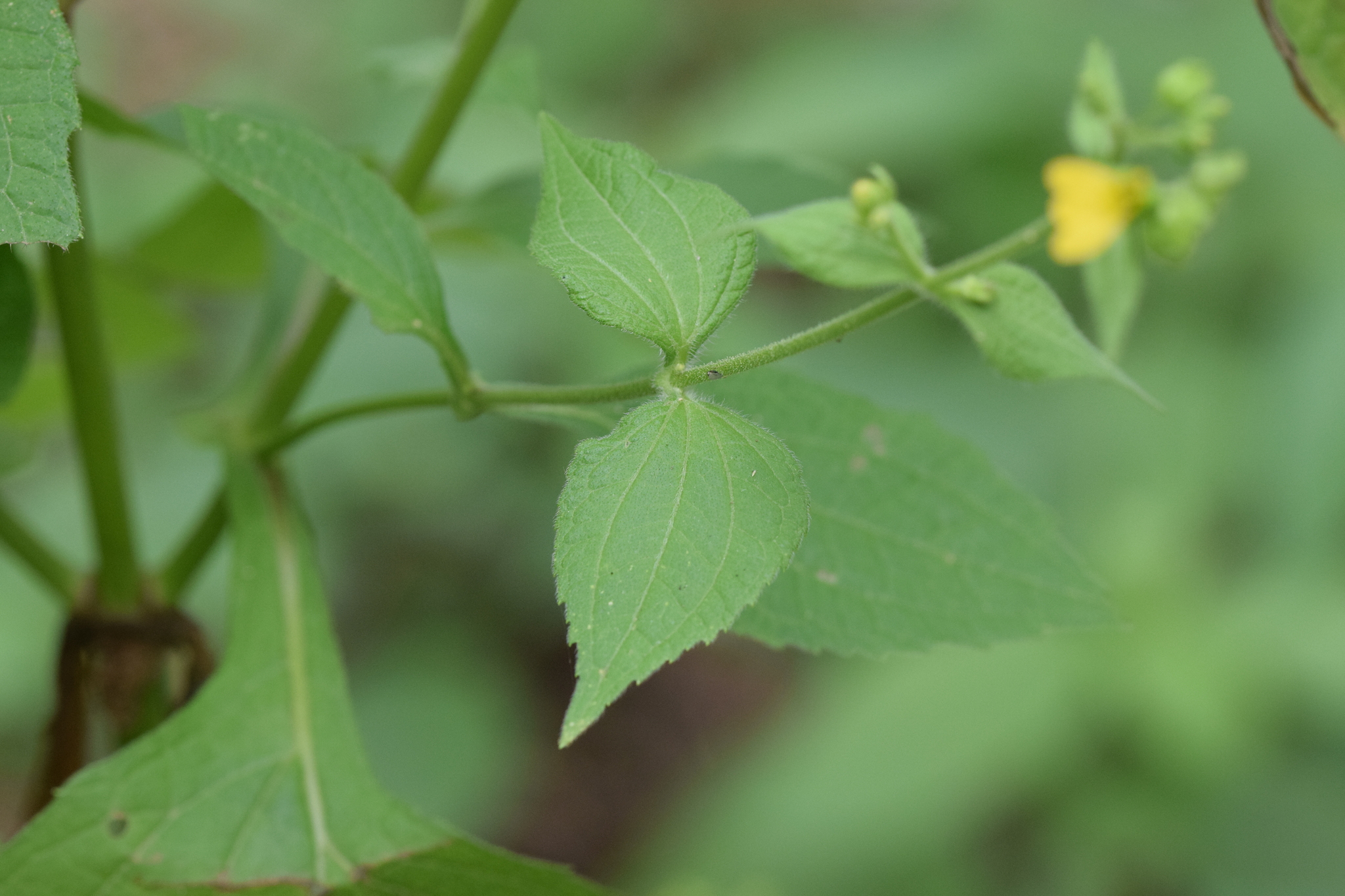
Milleria quinqueflora, with no commonly accepted English name, is a species of neotropical plant belonging to the family Asteraceae. It is the only species belonging to the genus Milleria.
Description
Milleria quinqueflora is a widespread, herbaceous, weedy, neotropical plant. As a monotypic member of the Asteraceae it's unusual because of its very reduced and modified flower heads. Here are other distinguishing features:
As a tap-rooted, branching, thin-stemmed, herbaceous plant living for just one year, it grows up to 2 metres (6.6 ft) or more tall. Leaves and stems are variously hairy, the outer ones with sticky glands among the hairs.
Leaves with pointed tips mostly arise opposite one another and are 3-nerved from their bases. Blades vary in shape but generally are somewhat egg-shaped, with margins almost without teeth or indentations ranging to conspicuously toothed. The blades, up to 25 cm (10 in) long and 18 cm (7 in) wide though usually smaller, at their bases grade into short petioles.
Flowering heads are arranged in panicles on short peduncles, the outer ones hairy with sticky glands. Involucral bracts usually are a little less than 4 mm (0.16 in) tall and variously hairy.
Flowering heads produce only 1 or rarely 2 ray florets with yellow, petal-like, deeply 3-lobed corollas up to 6 mm (0.24 in) long; these florets bear only female parts—are "pistillate"—and produce fruits. Beside the ray floret(s) there are 4 or 5 disk florets with cylindrical, green or greenish to yellow corollas about half as long as the ray floret corollas; disk florets bear purplish-black anthers but no female parts and produce no fruits.
One-seeded, cypsela-type fruits when mature usually are tightly enclosed within enlarged, hardened involucral bracts and form a rough-surfaced body of irregular shape around 5 mm (0.20 in) long.
Distribution
Milleria quinqueflora occurs throughout most of Mexico, except for the northeastern part, plus Cuba...