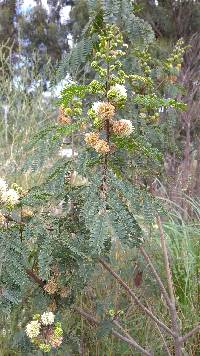
Leucaena leucocephala is a small fast-growing mimosoid tree native to southern Mexico and northern Central America (Belize and Guatemala). It is now naturalized throughout the tropics including parts of Asia.
Common names include white leadtree, white popinac, horse tamarind, ipil-ipil, koa haole, tan-tan, and tangantangan.
Leucaena leucocephala is used for a variety of purposes, such as fencing, soil fertility, firewood, fiber, and livestock fodder.
Description
Leaves
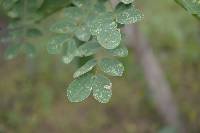
Leucaena leucocephala is a small tree, growing up to 7–18 metres (23–59 ft). Its bark is grey and cracked. The branches have no thorns, each branch has 6–8 pairs of leaf stalks that bear 11–23 pairs of leaflets, each leaflet is 8–17 mm long with a pale green surface and whitish underneath.
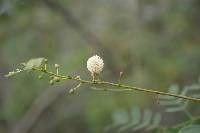
Its inflorescence is a cream-coloured puff with many stamens. They produce flat and straight seed pods measuring 13–18 cm (5.1–7.1 in) long that matures from a green colour to a brown; one pod contains between 15 and 30 seeds.
L. leucocephala pods in the month of May, Nepal
Dried L. leucocephala pod and seeds - MHNT
Ecology
Leucaena leucocephala is susceptible to insect infestations. In the 1980s, a widespread loss in Southeast Asia was due to pest attack by psyllids.
In India, this tree was initially promoted for afforestation due to its fast-growing nature. However, it is now considered unsuitable for urban planting because of its tendency to get uprooted in rain and wind. Eight of every ten trees uprooted by wind in Pune are L. leucocephala.
Invasive properties
Leucaena leucocephala is considered one of the 100 worst invasive species by the Invasive Species Specialist Group of the IUCN Species Survival Commission.
It is a highly invasive species in the arid parts of Taiwan, The Bahamas, the Hawaiian Islands, Fiji, Puerto Rico, Hong Kong, South Africa, and northern Australia, as well as in northern Malay Peninsula, South America and Southern Europe....