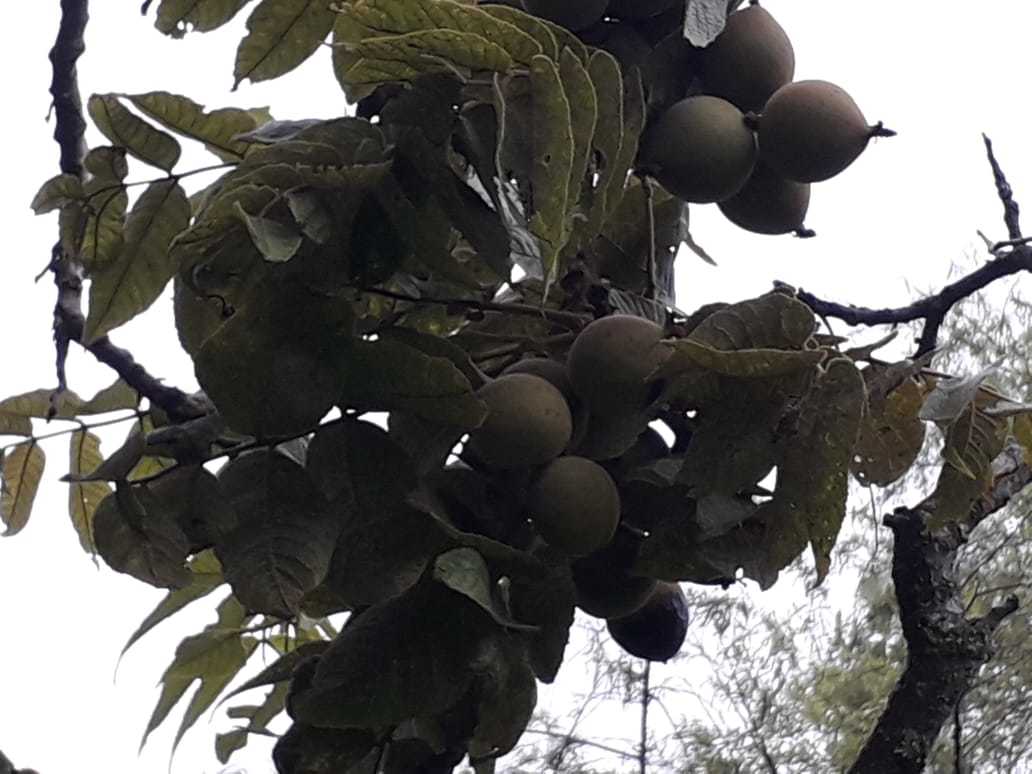
The Juglandaceae are an angiosperm family known as the walnuts. They are trees, or sometimes shrubs, in the order Fagales. Members of this family are native to the Americas, Eurasia, and Southeast Asia.
The nine or ten genera in the family have a total of around 63 species, and include the commercially important nut-producing trees walnut (Juglans), pecan (Carya illinoinensis), and hickory (Carya). The Persian walnut, Juglans regia, is one of the major nut crops of the world. Walnut, hickory, and gaulin are also valuable timber trees while pecan wood is also valued as cooking fuel.
The genetic relationships between different members of the family have recently been studied in more detail.
Description
Members of the walnut family are trees (rarely large shrubs) with aromatic leaves that are usually alternate, but opposite in Alfaroa and Oreomunnea. The leaves are pinnately compound or ternate, and usually 20–100 cm long. The trees are wind-pollinated, and both the male and female the flowers are usually arranged in catkins.Members of this family are often monoecious, but can be dioecious.
The fruits of the Juglandaceae are often confused with drupes but are accessory fruit because the outer covering of the fruit is technically an involucre and thus not morphologically part of the carpel; this means it cannot be a drupe but is instead a drupe-like nut.
Catkin of Juglans cinera (White walnut or Butternut)
@media all and (max-width:720px){
Nut of Juglans regia
Foliage and seed catkin of Platycarya strobilacea
Ecology
Members of Juglandaceae have been projected to experience a range shift as the climate changes. Species distribution models show that within Europe Juglans regia will experience a northward shift to stay within a climatically suitable habitat. Different climate scenarios were modeled, revealing that the severity of range shift will increase with greater temperature changes. Expansion could extend beyond the native range, making...