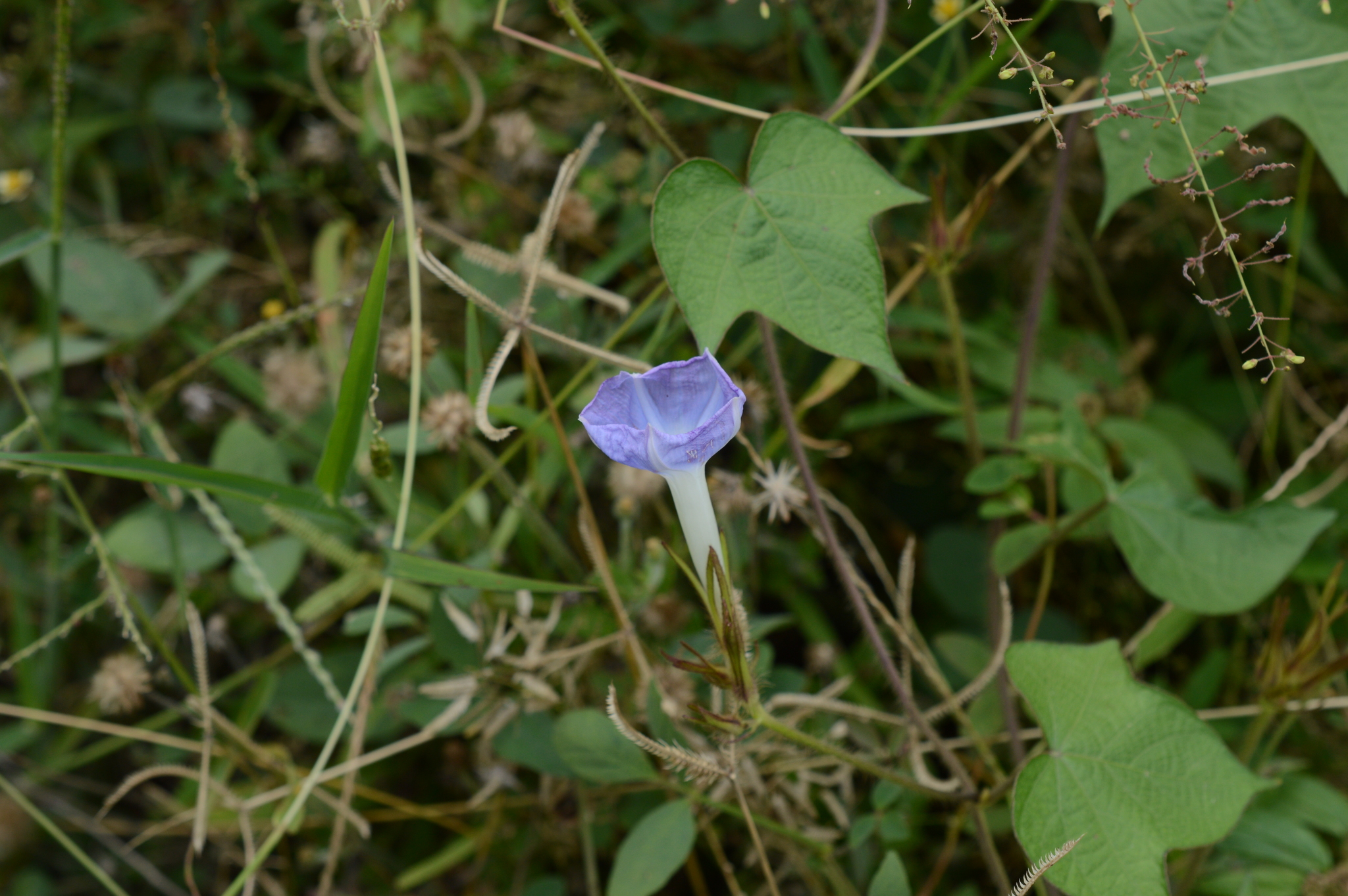
Ipomoea nil is a species of Ipomoea morning glory known by several common names, including picotee morning glory, ivy morning glory, ivy-leaf morning glory, and Japanese morning glory (although it is not native to Japan). It is native to the tropical Americas, and has been introduced widely across the world.
Description
Cultivated flower close-up
Wild form
Native to Central America and Mexico, the plant is a climber with twining stems up to 5 m long and is dense to scattered with long hairy trichomes. The finely hairy, emerald green leaves are ovate to almost circular, 5 to 14 cm long. The base is heart-shaped, the edge is entire or lobed three to five times, the leaf lobes are pointed or tapering. The species, especially its wild form, is extremely similar to Ipomoea hederacea.
The funnel-shaped, colorful flowers (blue to reddish-purple, with whitish tube) are quite showy and are individually up to five in often dense cymose groups, in which fully developed flowers and developing buds stand together. The wild forms are smaller than cultivated forms, and are almost always blue; the cultivated forms come in a wide variety of colors. They open in the morning and close by the afternoon. The long, thorny hairy sepals have a length of 15 to 25 mm, they are long, lanceolate, and have a linear-lanceolate tip. The crown is blue, purple, or almost scarlet red. The throat is often colored white. The crown tube has a length of 3 to 5 cm, the crown hem has a width of 4 to 5 cm.
The fruits are almost spherical to spherical capsule fruits with a diameter of 8 to 12 mm. The seeds are pear-shaped and densely covered with short trichomes.
Cultivation
It is cultivated as an ornamental plant in many places, and the descendants of garden escapees now grow wild. Fast-growing and self-seeding, it may be used to hide unsightly fences or walls, and may also be used decoratively on trellises. The flowers are several centimeters wide and appear in various shades of blue, pink or rose, often...