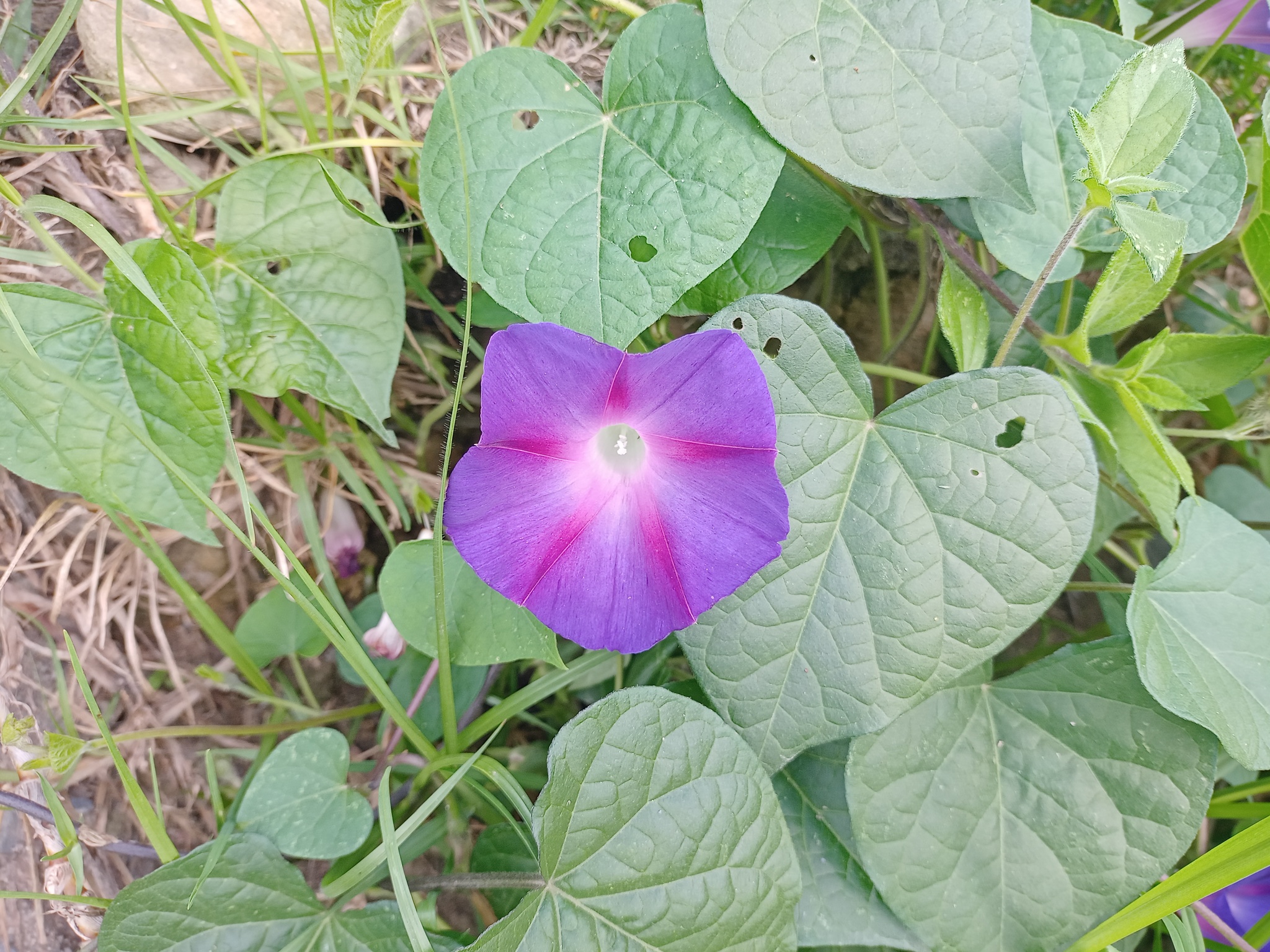
Ipomoea () is the largest genus in the plant family Convolvulaceae, with over 600 species. It is a large and diverse group, with common names including morning glory, water Convolvulus or water spinach, sweet potato, bindweed, moonflower, etc. The genus occurs throughout the tropical and subtropical regions of the world, and comprises annual and perennial herbaceous plants, lianas, shrubs, and small trees; most of the species are twining climbing plants.
Description
Ipomoea are annual or perennial twining, prostrate or erect, herbs, shrubs, lianas, or trees usually with twining or trailing stems bearing simple, or rarely compound leaves.
The few- to many-flowered, axillary, solitary or cymose inflorescences bear small to large, blue, red, pink, purple, white, orange, or yellow, pentamerous flowers.
Vegetative characteristics
Ipomoea are annual or perennial twining, prostrate or erect, herbs, shrubs, lianas, or trees usually with twining or trailing stems bearing simple, or rarely compound leaves.
Generative characteristics
The few- to many-flowered, axillary, solitary or cymose inflorescences bear small to large, blue, red, pink, purple, white, orange, or yellow, pentamerous flowers.
Taxonomy
The genus Ipomoea L. was described by Carl Linnaeus in 1753. It has 642 accepted species. The type species is Ipomoea pes-tigridis L. Within the family Convolvulaceae, it is placed in the tribe Ipomoeeae.
Their most widespread common name is morning glory, but some species in related genera bear that same common name and some Ipomoea species are known by different common names. Those formerly separated in Calonyction (Greek καλός kalós "good" and νύξ, νυκτός núx, nuktós, "night") are called moonflowers.
The name Ipomoea is derived from the Ancient Greek ἴψ, meaning 'woodworm', and ὅμοιος (hómoios), meaning "resembling". It refers to their twining habit.