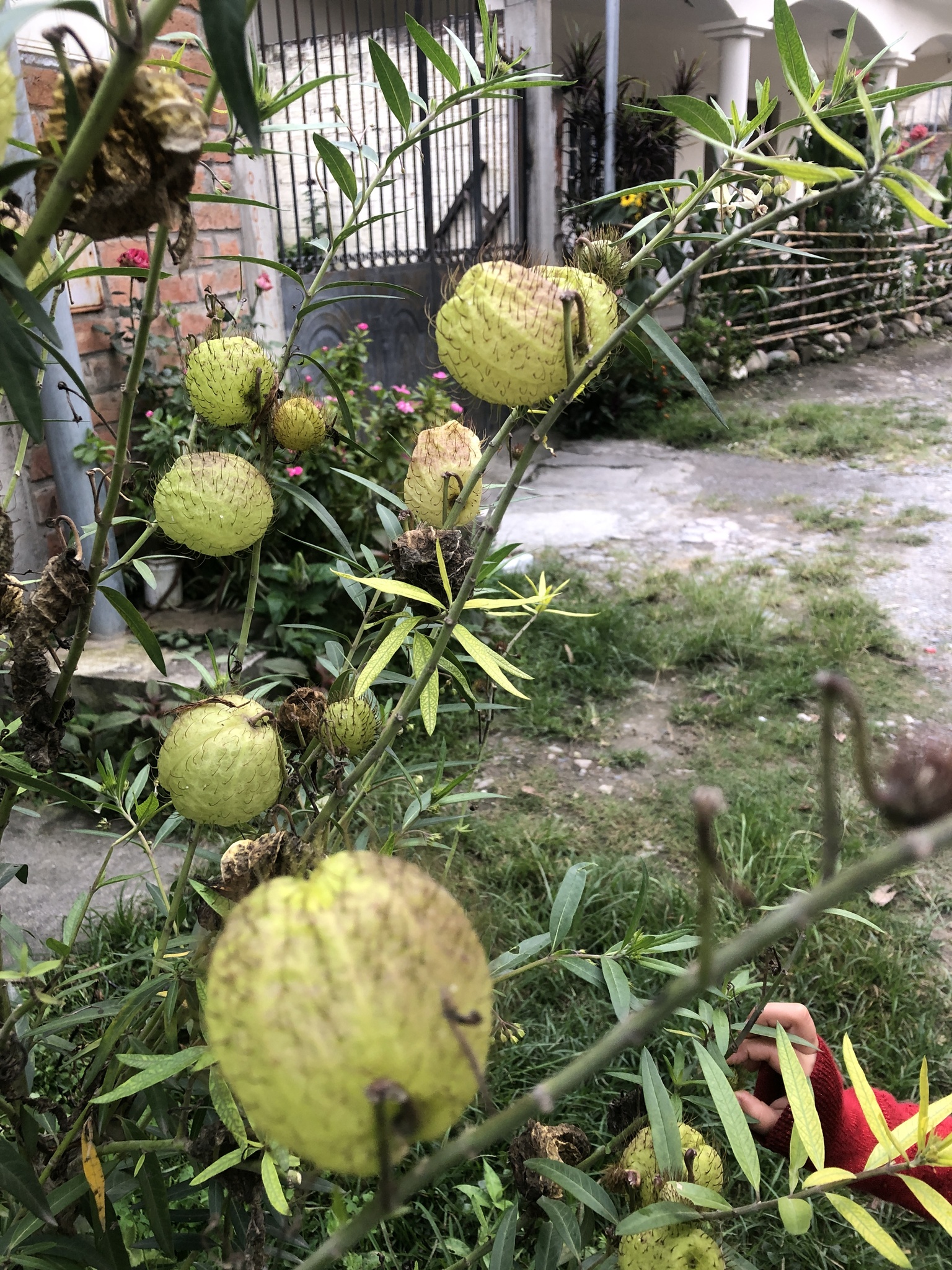
Gomphocarpus physocarpus is a species of flowering plant in the Milkweed subfamily, Asclepiadoideae, and Dogbane Family Apocynaceae. It is commonly known as hairy balls, balloonplant, balloon cotton-bush, bishop's balls, nailhead, or swan plant. The plant is native to southeast Africa, but it has been widely naturalised as it is often used as an ornamental plant.
Description
Monarch butterfly caterpillars feeding on Gomphocarpus physocarpus
Gomphocarpus physocarpus is an undershrub perennial herb, that can grow to 2 m (6 ft 7 in) tall with narrow lanceolate leaves. The plant blooms in warm months. It grows on roadside banks, at altitudes of 850–1,500 m (2,790–4,920 ft) above sea level. The plant prefers moderate moisture, as well as sandy and well-drained soil and full sun.
Its propagation can be done by seeds or by cuttings. The seeds can be sown in a light, well-drained substrate. Cuttings about 10 cm long with the basal leaves removed can be planted in a pot with light, well-draining substrate.
Gomphocarpus physocarpus is traditionally used to produce ointments for the treatment of warts and the seeds are used in rituals. The leaves and stems produce milky latex that contains carbohydrates, cardiac glycosides (cardenolides), terpenoids, alkaloids, and phenols.
The flowers are small, with white hoods and about 1 cm across. The follicle (a type of fruit) is a pale green, in shape an inflated spheroid, and filled with air. It is covered with rough hairs. It reaches 8 cm (3.1 in) diameter. The leaves are light green, linear to lanceolate and 7–10 cm (2.8–3.9 in) long, 1.2 cm (0.47 in) broad. The brown seeds have silky tufts.
This plant will readily hybridize with Gomphocarpus fruticosus creating intermediate forms.
Other names for the plant include in Afrikaans: balmelkbossie, balbossie, wilde kapok and in Zulu: umbababa, umbemiso, umangwazane, umqumnqwewe, uphuphuma,...