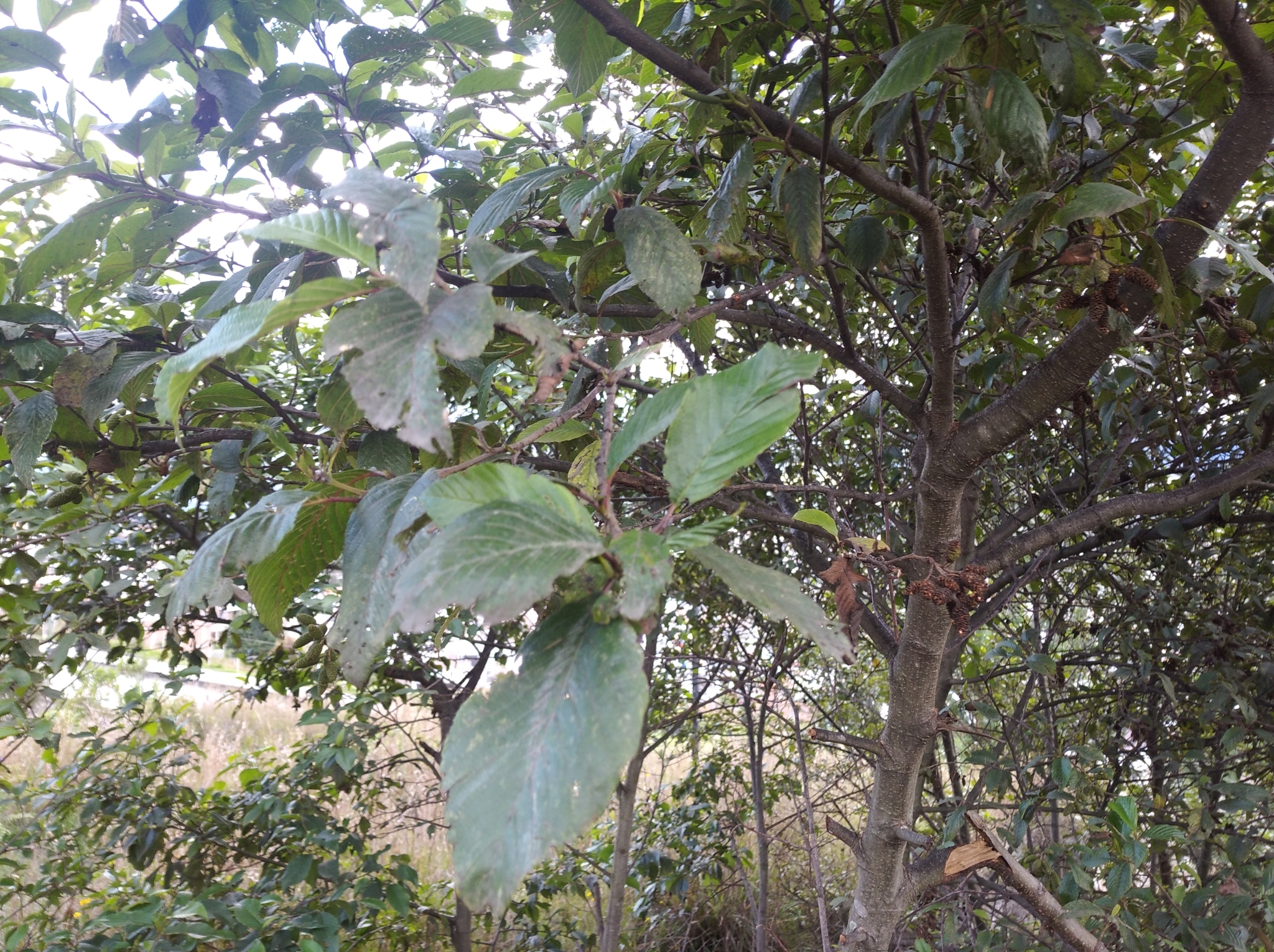
Alders are trees of the genus Alnus in the birch family Betulaceae. The genus includes about 35 species of monoecious trees and shrubs, a few reaching a large size, distributed throughout the north temperate zone with a few species extending into Central America, as well as the northern and southern Andes.
Description
Pollen
With a few exceptions, alders are deciduous, and the leaves are alternate, simple, and serrated. The flowers are catkins with elongate male catkins on the same plant as shorter female catkins, often before leaves appear; they are mainly wind-pollinated, but also visited by bees to a small extent. These trees differ from the birches (Betula, another genus in the family) in that the female catkins are woody and do not disintegrate at maturity, opening to release the seeds in a similar manner to many conifer cones.
The largest species are red alder (A. rubra) on the west coast of North America, and black alder (A. glutinosa), native to most of Europe and widely introduced elsewhere, both reaching over 30 metres (100 ft). By contrast, the widespread Alnus alnobetula (green alder) is rarely more than a 5 m-tall (16 ft) shrub.
Etymology
The common name alder evolved from the Old English word alor, which in turn is derived from Proto-Germanic root aliso. The generic name Alnus is the equivalent Latin name, from whence French aulne and Spanish Alamo (Spanish term for "poplar").
Ecology
Alders are commonly found near streams, rivers, and wetlands. Sometimes where the prevalence of alders is particularly prominent these are called alder carrs. In the Pacific Northwest of North America, the white alder (Alnus rhombifolia) unlike other northwest alders, has an affinity for warm, dry climates, where it grows along watercourses, such as along the lower Columbia River east of the Cascades and the Snake River, including Hells Canyon.
Alder leaves and sometimes catkins are used as food by numerous butterflies and moths.