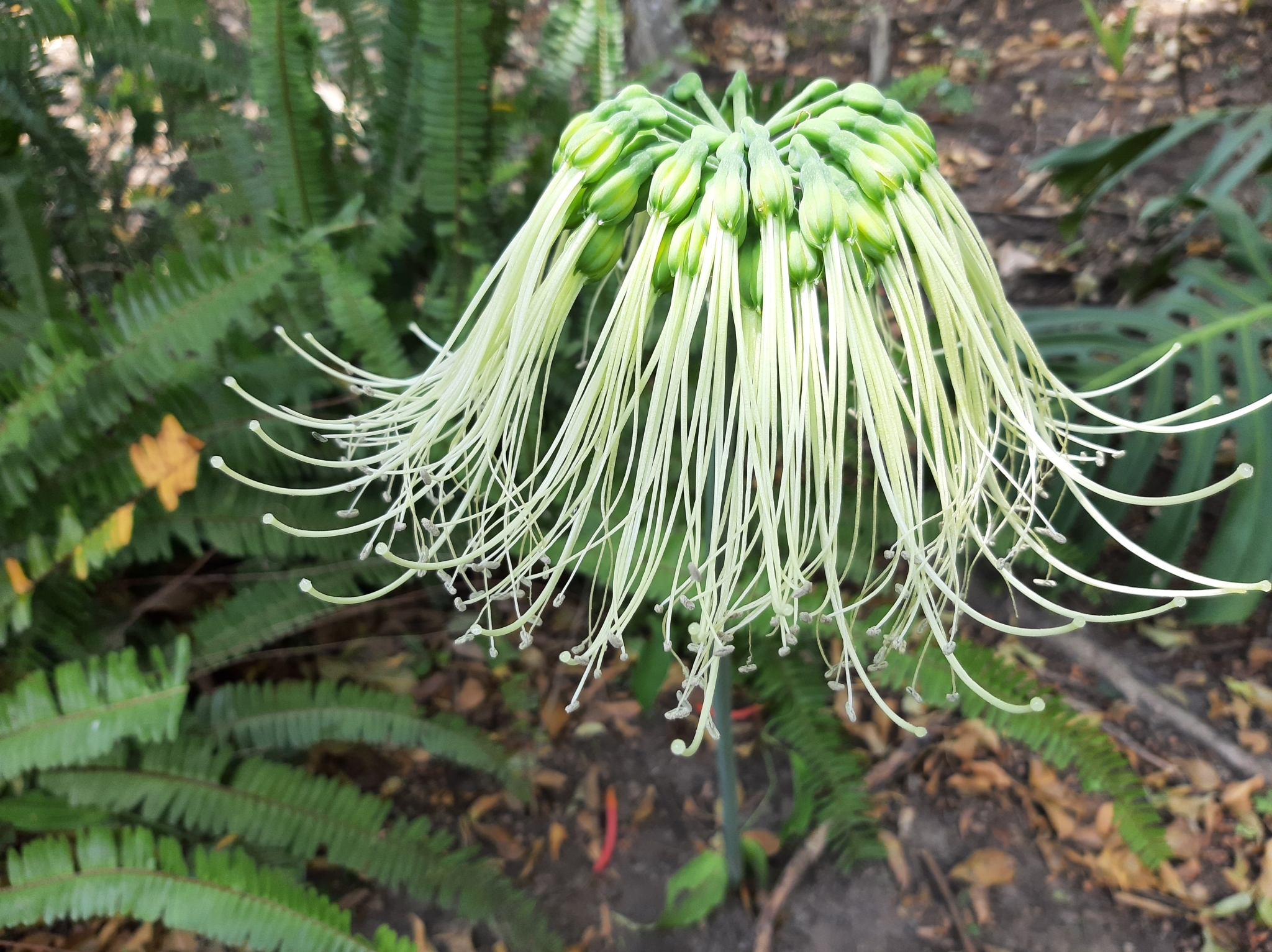
Eucrosia is a genus of herbaceous, perennial and bulbous plants in the Amaryllis family (Amaryllidaceae, subfamily Amaryllidoideae) distributed from Ecuador to Peru. The name is derived from the Greek eu, beautiful, and krossos, a fringe, referring to the long stamens. As circumscribed in 2020, the genus contains six species. Phaedranassa and Rauhia are the genera most closely related to Eucrosia.
Description
Eucrosia aurantiaca
All the members of the genus are bulbous. The leaves are deciduous, with characteristic long petioles and elliptical or ovate blades (laminae), up to 25 cm wide; they may or may not be present when the flowers are produced. The inflorescence is an umbel of 6–30 weakly to strongly zygomorphic flowers, tubular at the base, green, yellow or red in colour. The stamens hang downwards (i.e. are declinate) and have long filaments which in most species form a cup containing nectaries at the base. The flowers are assumed to be adapted for butterfly pollination, although there is one report of a hummingbird visiting E. eucrosioides. The fruit is a capsule with three locules; the seeds are flattened and winged. The diploid chromosome number is most commonly 2n=46.
Taxonomy
The genus name Eucrosia was published by John Bellenden Ker Gawler in 1817 with Eucrosia bicolor Ker Gawl. as the type species.
As of August 2025, Plants of the World Online accepted six species:
Eucrosia aurantiaca (Baker) Pax – southern central Ecuador
Eucrosia bicolor Ker Gawl. – Ecuador to Peru
Eucrosia calendulina Meerow & Sagást. – Peru
Eucrosia eucrosioides (Herb.) Pax – southwestern Ecuador to northern Peru
Eucrosia mirabilis (Baker) Pax – Peru, Ecuador
Eucrosia stricklandii (Baker) Meerow – Ecuador
Two formerly accepted species have been moved to other genera: