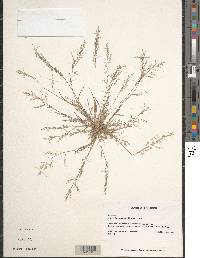
Eragrostis mexicana, the Mexican lovegrass, is an annual grass found from North America down to Argentina. Its specific epithet "mexicana" means "from Mexico". Its diploid number is 60.
Taxonomy
Eragrostis mexicana was formerly four distinct Eragrostis species: E. mexicana, E. neomexicana, E. orcuttiana, and E. virescens. They are now united into E. mexicana, with the first two species forming E. mexicana subsp. mexicana and the last two forming E. mexicana subsp. virescens. All four former species are related by their diploid number of 60, their flowers with three stamens, and dark brown, reticulate caryopses. The two subspecies differ in the occurrence of glandular depressions below culm nodes, spikelet color, and plant size. Subspecies mexicana consists of smaller (15–50 cm (5.9–19.7 in) tall) grasses lacking glands with more purplish spikelets, while subspecies virescens consists of larger (75–120 cm (30–47 in) tall) grasses possessing glands with grey-green spikelets. The former grows in compact soil while the latter grows in cultivated areas.