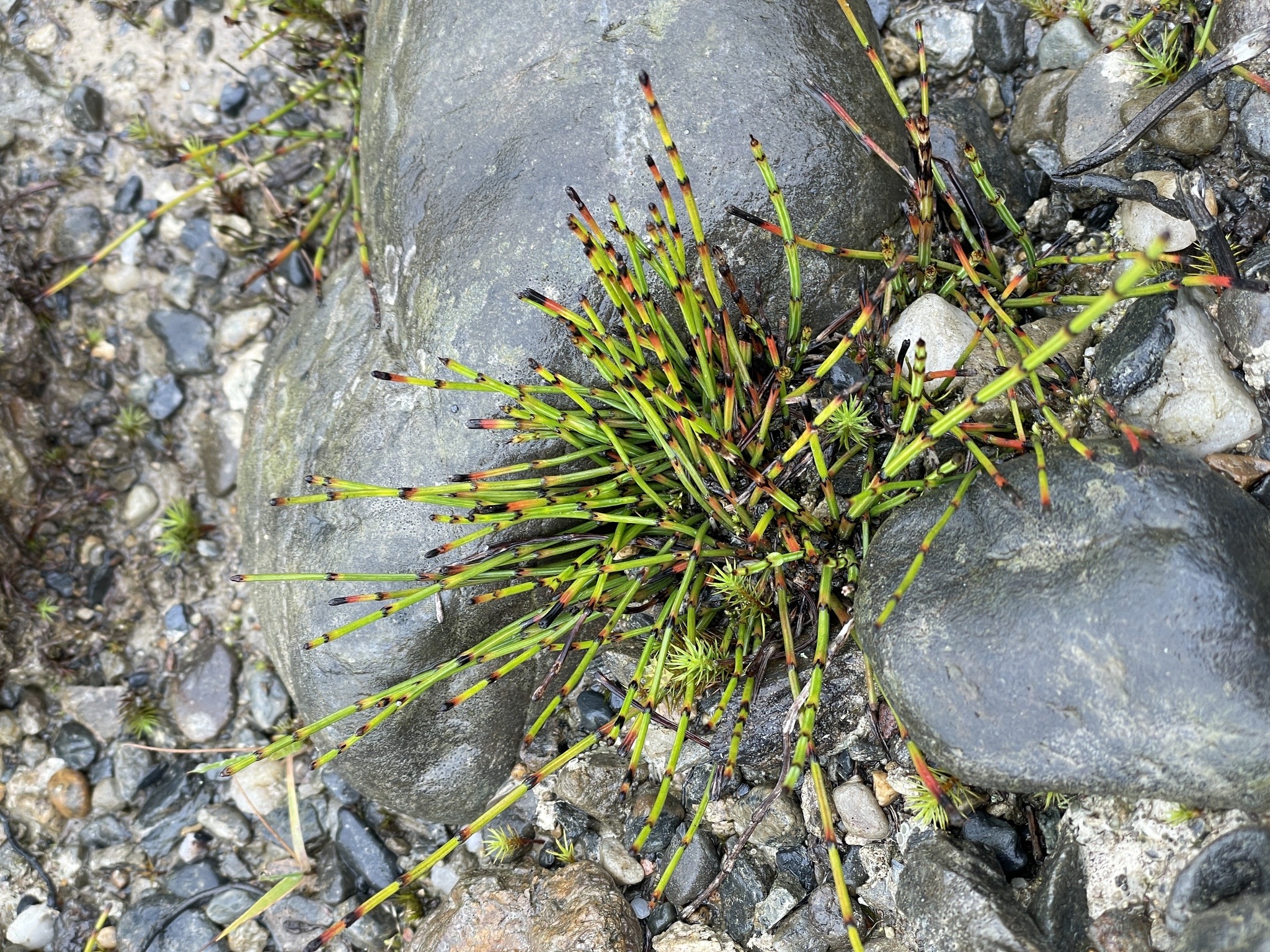
Equisetum (; horsetail) is the only living genus in Equisetaceae, a family of vascular plants that reproduce by spores rather than seeds. The oldest remains of modern Equisetum species first appear in the Early Jurassic.
The genus is near-cosmopolitan. In some areas the species are considered weeds or invasive. The plants are toxic, containing thiaminase, but have been prepared as food or folk medicine.
Description
They are perennial plants, herbaceous and dying back in winter in most temperate species, or evergreen as most tropical species and the temperate species E. hyemale (rough horsetail), E. ramosissimum (branched horsetail), E. scirpoides (dwarf horsetail) and E. variegatum (variegated horsetail). They typically grow
Equisetum leaves are greatly reduced and usually non-photosynthetic. They contain a single, non-branching vascular trace, which is the defining feature of microphylls. However, it has been recognised in 1999 that horsetail microphylls are probably not ancestral as in lycophytes (clubmosses and relatives), but rather derived adaptations, evolved by reduction of megaphylls.
The leaves of horsetails are arranged in whorls fused into nodal sheaths. The stems are usually green and photosynthetic, and are distinctive in being hollow, jointed and ridged (with sometimes 3 but usually 6–40 ridges). There may or may not be whorls of branches at the nodes. Unusually, the branches often emerge below the leaves in an internode, and grow from buds between their bases.
Vegetative stem: B = branch in whorl I = internode L = leaves N = node
Strobilus of E. braunii on an unbranched stem
Microscopic view of E. hyemale (rough horsetail), about 4.5 mm in diameter. The small white dots are accumulated silicates on cells.
The spores are borne under sporangiophores in strobili, cone-like structures at the tips of some of the stems. In many species the cone-bearing shoots are unbranched, and in...