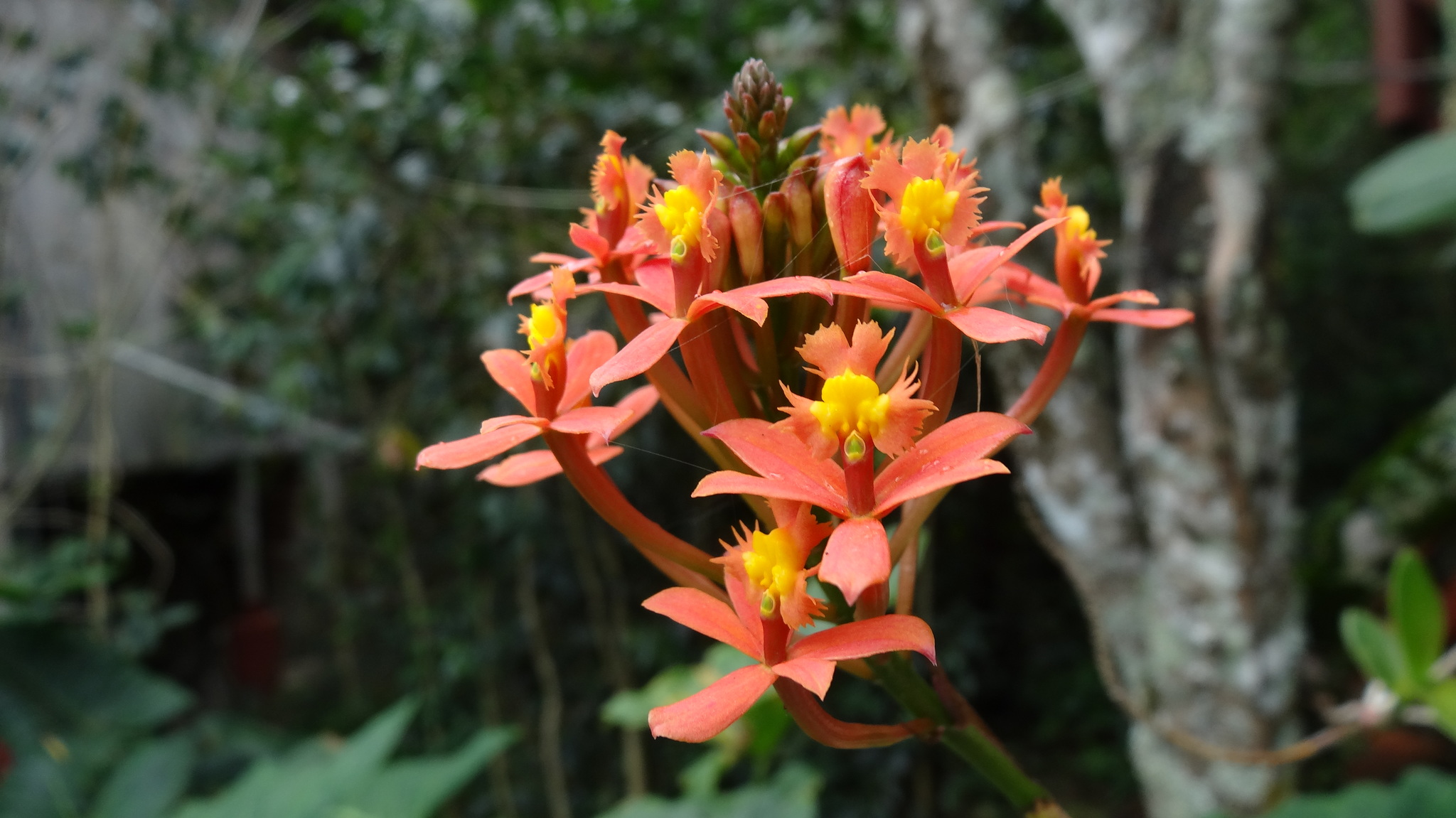
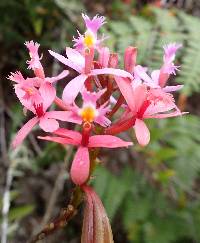
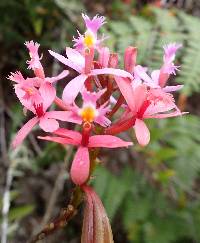
Epidendrum secundum, one of the crucifix orchids, known as the lopsided star orchid, is a poorly understood reed stemmed species, which Dressler (1989) describes as "the Epidendrum secundum complex." According to Dressler, there are dozens of varieties, some of which appear to deserve species rank. Arditti and Ghani note that E. secundum has the distinction of bearing the longest seeds known in the Orchidaceae, 6.0 mm long. By comparison, the seeds of E. ibaguense (another crucifix orchid) are only 2.9 mm long.
Description
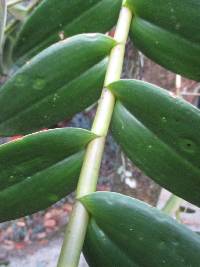
Like the other members of E. subg. Amphiglottium, E. secundum is a sympodial plant which has thin stems covered from the base with imbricating sheaths which are leaf bearing above, a terminal inflorescence covered at its base with thin imbricating sheaths, and flowers with the lip adnate to the column to its apex. The flowers are non-resupinate (unlike E. ibaguense and E. radicans), can come in shades of lilac, red, orange, or yellow, and feature a notable callus on the fringed trilobate lip. The plant is rather cold-tolerant and can tolerate a light frost.
Diversity within the complex
Epidendrum secundum, also called "Wiñay Wayna orchid", in front of the Wiñay Wayna ruins
In 1861, H. R. Reichenbach presented a treatment of the genus Epidendrum, including his view of the sub-section Tuberculata. Correlating his list of (in Reichenbach's view) separate species with the Kew Monocot Checklist (July 16, 2009) yielded the following list of taxa "which appear to deserve species rank" that Kew checklist reviewers consider to be synonyms for E. secundum (the page numbers refer to Reichenbach 1861):
E. ansiferum Rchb.f. & Warsz., Bonplandia (Hannover) 2: 111 (1854). (pp 394–395)
E. brachyphyllum Lindl., Fol. Orchid. 3:72(1853) (p. 392)
E. fimbria Rchb.f., Bonplandia (Hannover) 2: 282 (1854). (p. 394)
E. gracilicaule Rchb.f. & Warsz., Bonplandia (Hannover) 2: 111 (1854) (p. 392)
E. incisum Rchb.f. & Warsz.,...