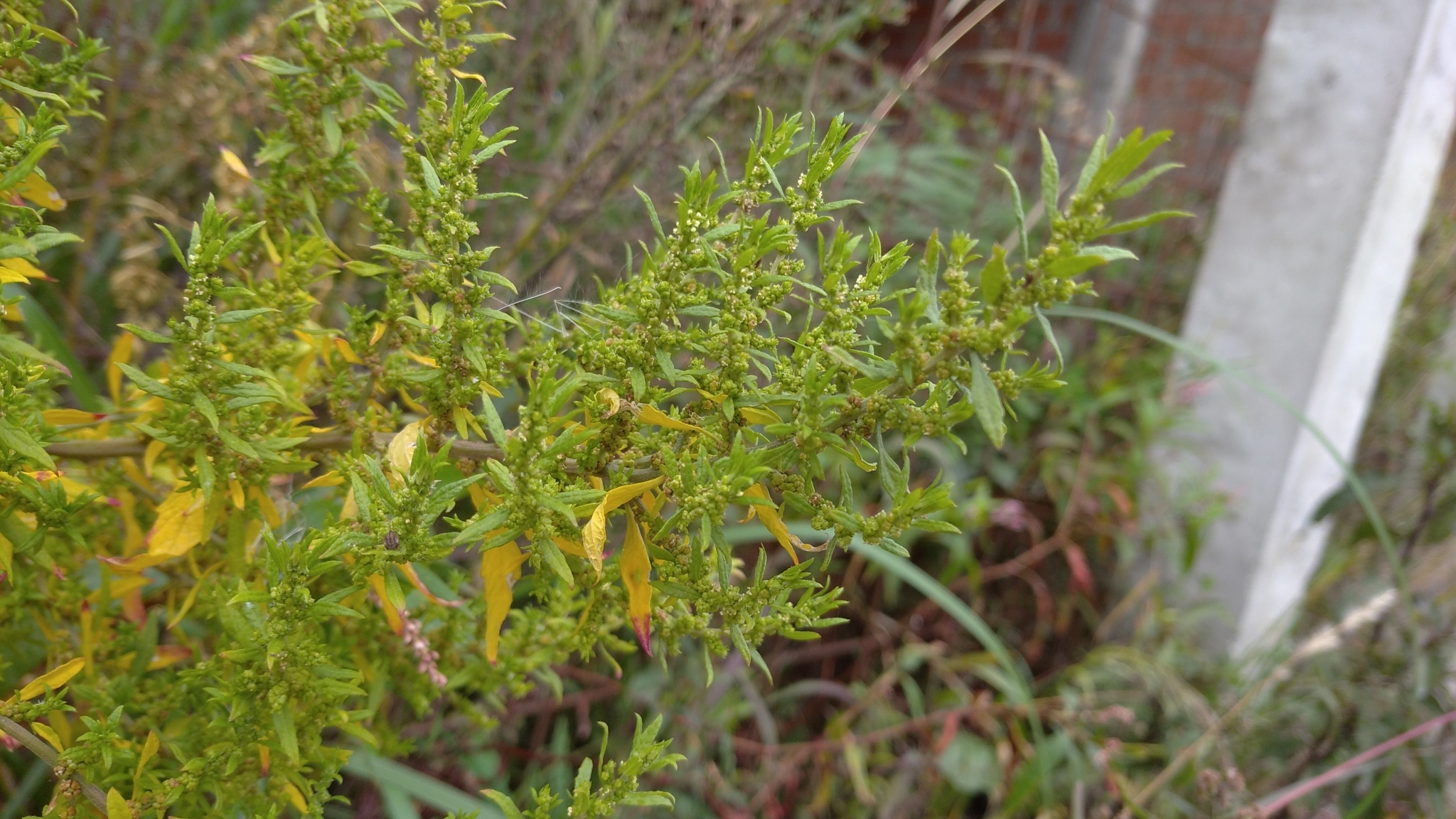
Dysphania ambrosioides, formerly Chenopodium ambrosioides, known as epazote, Jesuit's tea, Mexican tea or wormseed, is an annual or short-lived perennial herb native to the Americas.
Description
Dysphania ambrosioides is an annual or short-lived perennial herb, growing to 1.2 m (4 ft) tall, irregularly branched, with oblong-lanceolate leaves up to
As well as in its native areas, it is grown in warm temperate to subtropical areas of Europe and the United States (Missouri, New England, Eastern US), sometimes becoming an invasive weed.
Dysphania ambrosioides – MHNT
Epazote essential oil contains ascaridole (up to 70%), limonene, p-cymene, and smaller amounts of numerous other monoterpenes and monoterpene derivatives (α-pinene, myrcene, terpinene, thymol, camphor and trans-isocarveol). Ascaridole (1,4-peroxido-p-menth-2-ene) is rather an uncommon constituent of spices; another plant owing much of its character to this monoterpene peroxide is boldo. Ascaridole is slightly toxic and has a pungent, not very pleasant flavor. In pure form, ascaridole decomposes violently upon heating, but this is relatively weak in regards to energy release, since breaking the oxygen bond will not destroy the entire molecule. Ascaridole content is lower in epazote from Mexico than in epazote grown in Europe or Asia.
Chemistry
Dysphania ambrosioides – MHNT
Epazote essential oil contains ascaridole (up to 70%), limonene, p-cymene, and smaller amounts of numerous other monoterpenes and monoterpene derivatives (α-pinene, myrcene, terpinene, thymol, camphor and trans-isocarveol). Ascaridole (1,4-peroxido-p-menth-2-ene) is rather an uncommon constituent of spices; another plant owing much of its character to this monoterpene peroxide is boldo. Ascaridole is slightly toxic and has a pungent, not very pleasant flavor. In pure form, ascaridole decomposes violently upon heating, but this is relatively weak in regards to energy release, since breaking the oxygen bond will not...