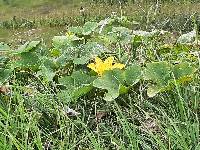
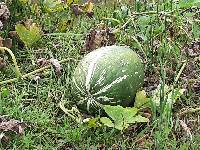
Cucurbita ficifolia is a species of squash, grown for its edible seeds, fruit, and greens native to the Americas. It has common names including black seed squash, chilacayote, cidra, fig-leaf gourd, and Malabar gourd. This species is grown widely from Argentina and Chile to Mexico. It is also cultivated in regions of the world including India, Japan, Korea, China, the Philippines, Ethiopia, Kenya, Tanzania, and Angola.
No named agricultural cultivars have been recognized. Compared to other domesticated Cucurbita species, samples of C. ficifolia gathered throughout its range are relatively similar to one other in morphology and genetic composition. Variations do occur in fruit and seed color, some isozymes, and photoperiod sensitivity.
Common names
Asian pumpkin
black-seed squash
chilacayote
chiverri or chiverre
cidra
citron chayote
figleaf gourd, fig-leaf gourd, fig-leaved gourd
lacayote
Malabar gourd
pie melon
shark fin gourd or shark fin melon
Siam squash
sidra
Thai marrow
Victoria
" Multilingual taxonomic information". University of Melbourne.
Description
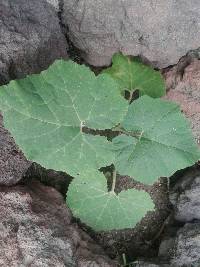
Early botanical keys described Cucurbita ficifolia as a perennial that is grown as an annual in temperate climates. More recent investigations have found that C. ficifolia is an annual that does not differ in longevity from the other annual domesticated Cucurbita species. As with these other annual species, C. ficifolia can have a vine habit that can root at the nodes. Provided proper conditions including a frost-free climate, it can grow for an indefinite amount of time in this manner. The plant stem can grow five to fifteen meters and produces tendrils that help it climb adjacent plants and structures. Its leaves resemble fig leaves, hence its Latin species name ficifolia, which means fig leaf.
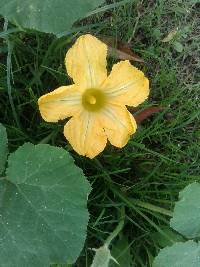
The plant is monoecious with imperfect flowers (meaning its flowers are either male or female but both sexes can be found on the same plant) and are pollinated by insects, especially bees. The color of the flowers is...