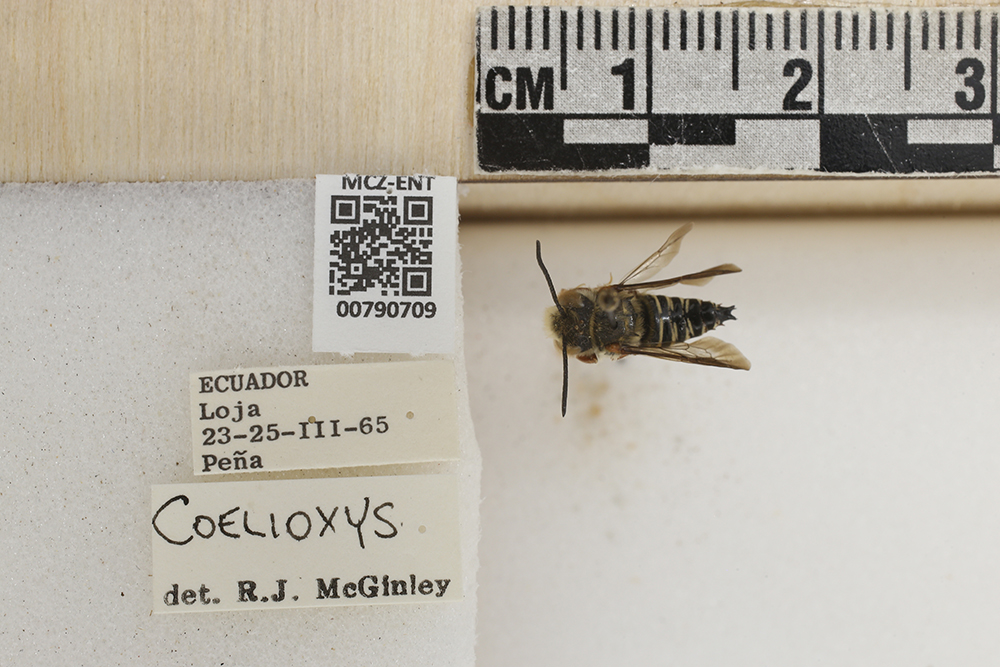
Coelioxys, common name leaf-cutting cuckoo bees or sharp-tailed bees, is a genus of solitary kleptoparasitic cuckoo bees belonging to the family Megachilidae.
Diversity
The genus includes about 500 species in 15 subgenera.
Note that many adjectives need correcting to fit the masculine for gender agreement. The genus ending -oxys is from Latinized Greek and is masculine, despite any earlier usage of feminine adjectives.
Distribution
Coelioxys species can be found in most European countries, in the Afrotropical realm, in the East Palearctic realm, in North Africa, in India, in the Nearctic and Neotropics.
Description
Bees within this genus can reach a length of 8–12 millimetres (0.31–0.47 in). They show a broad head with large complex eyes and broad thorax and abdomen. Their body is only moderately hairy. They are usually black with white hair stripes. Legs may be red or black. The females of Coelioxys species have a long pointed abdomen that resembles a cone, used to pierce the leaf lining in the laying of eggs. The male's abdomen is armed with spines or teeth.
They are known to sometimes sleep upside down on vegetation.
Coelioxys sp. sleeping, held in place by its mandibles
Biology
These cuckoo bees are usually active from June to September, depending on the specific host species. They have no pollen-carrying adaptations, as they do not need to provision nests. Adults feed on nectar at flowers of a wide range of different nectar plants. In fact they mainly lay their eggs in the nests of bees in the genus Megachile, but...