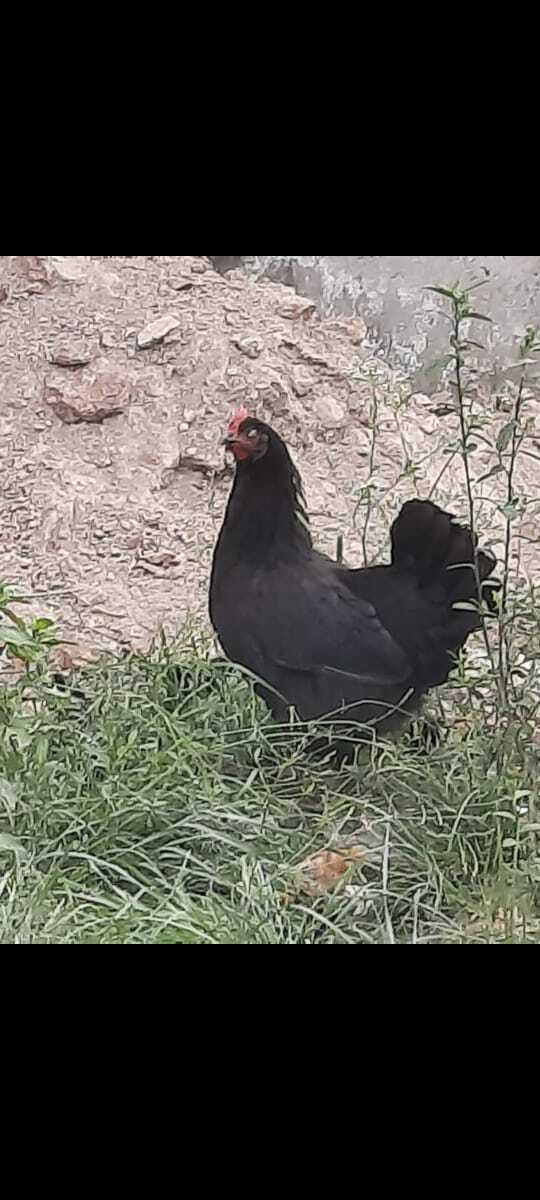
The red junglefowl (Gallus gallus), also known as the Indian red junglefowl (and formerly the bankiva or bankiva-fowl), is a species of tropical, galliform bird in the phasianid family, found across much of Southeast Asia and parts of South Asia.
The red junglefowl was the primary species to give rise to today's many breeds of chicken (G. g. domesticus). Lesser contributions came from the grey junglefowl (G. sonneratii), Sri Lankan junglefowl (G. lafayettii) and the Javanese green junglefowl (G. varius). Whole genome sequencing has revealed that the chicken was first domesticated from red junglefowl ca. 8,000 years ago, with this domestication event involving multiple maternal origins.
The domesticated variant is raised worldwide by humans in their tens of billions for their meat, eggs, colourful plumage and companionship. The wild form of G. gallus is sometimes used in zoos, parks or botanical gardens as a form of pest control, similarly to—and often kept with—the Indian peafowl (Pavo cristatus) or the helmeted guinea fowl (Numida meleagris).
Taxonomy
The red junglefowl was formally described in 1758 by the Swedish naturalist Carl Linnaeus in the tenth edition of his Systema Naturae under the binomial name Phasianus gallus. Linnaeus specified the type locality as "India orientali" but this has been restricted to the island of Pulo Condor (Côn Đảo) off the coast of Vietnam. The red junglefowl is now one of the four species placed in the genus Gallus that was introduced in 1760 by Mathurin Jacques Brisson. The word gallus is Latin for a farmyard cockerel.
body.skin-vector-2022
Gallus
Green junglefowl–Gallus varius (Shaw, 1798)
Red junglefowl–Gallus gallus (Linnaeus, 1758)
Sri Lankan junglefowl–Gallus lafayettii (Lesson, 1831)