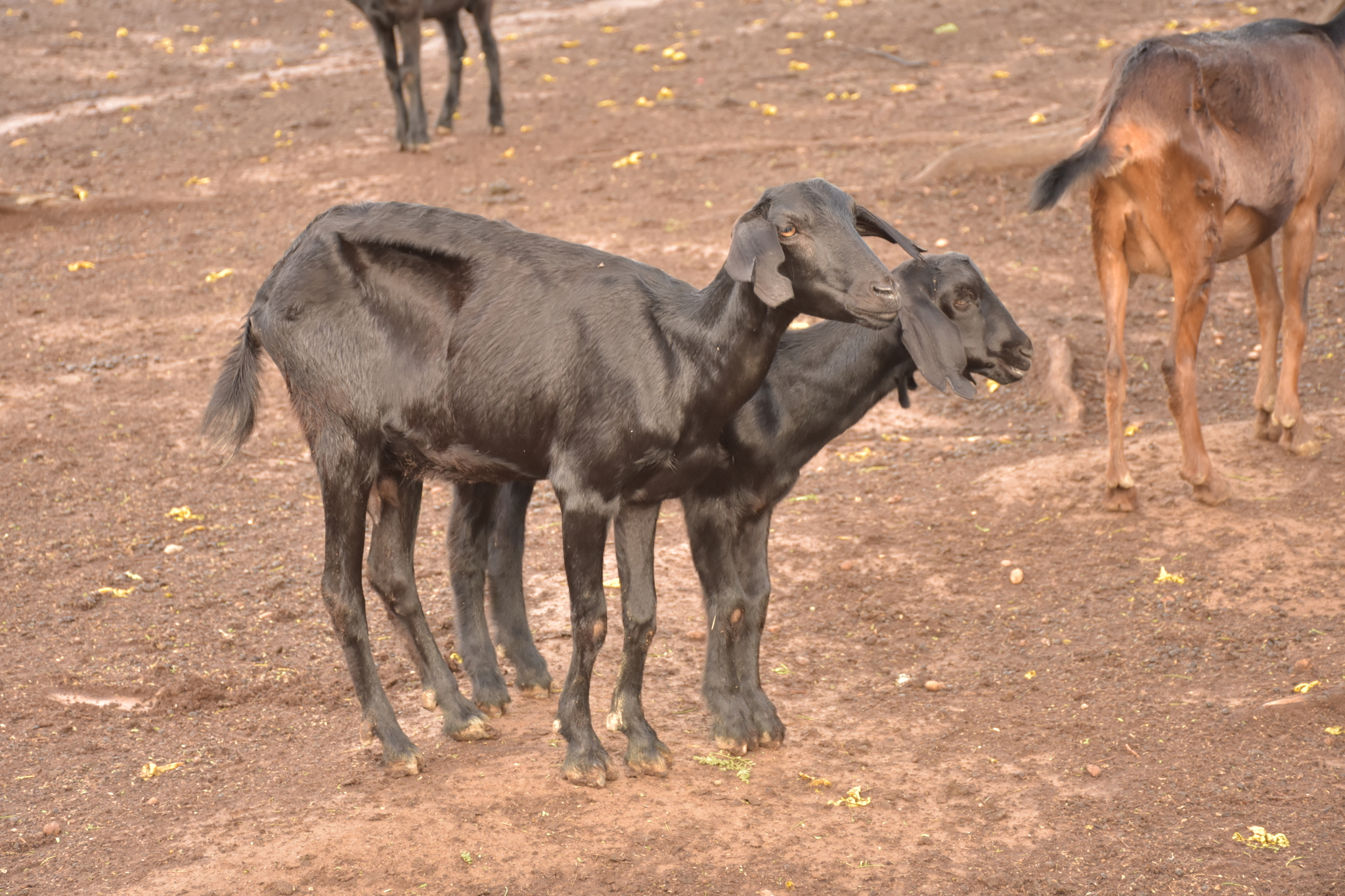
The subfamily Caprinae, also sometimes referred to as the tribe Caprini, is part of the ruminant family Bovidae, and consists of mostly medium-sized bovids. A member of this subfamily is called a caprine.
Prominent members include sheep and goats, with some other members referred to as goat antelopes. Some earlier taxonomies considered Caprinae a separate family called Capridae (with the members being caprids), but now it is usually considered either a subfamily within the Bovidae, or a tribe within the subfamily Antilopinae of the family Bovidae, with caprines being a type of bovid.
Characteristics
Skeleton of a Barbary sheep (Ammotragus lervia) on display at the Museum of Osteology
Although most goat-antelopes are gregarious and have fairly stocky builds, they diverge in many other ways – the muskox (Ovibos moschatus) is adapted to the extreme cold of the tundra; the mountain goat (Oreamnos americanus) of North America is specialised for very rugged terrain; the urial (Ovis orientalis) occupies a largely infertile area from Kashmir to Iran, including much desert country. The Armenian mouflon (Ovis gmelini gmelini) is thought to be the ancestor of the modern domestic sheep (Ovis aries).
Many species have become extinct since the last ice age, probably largely because of human interaction. Of the survivors:
Five are classified as endangered
Eight as vulnerable
Seven as of concern and needing conservation measures, but at lower risk
Seven species are secure
Members of the group vary considerably in size, from just over 1 m (3 ft) long for a full-grown grey goral (Naemorhedus goral), to almost 2.5 m (8 ft 2 in) long for a musk ox, and from under 30 kg (66 lb) to more than 350 kg (770 lb). Musk oxen in captivity have reached over 650 kg (1,430 lb).
The lifestyles of caprids fall into two broad classes: 'resource-defenders', which are territorial and defend a small, food-rich area against other members...