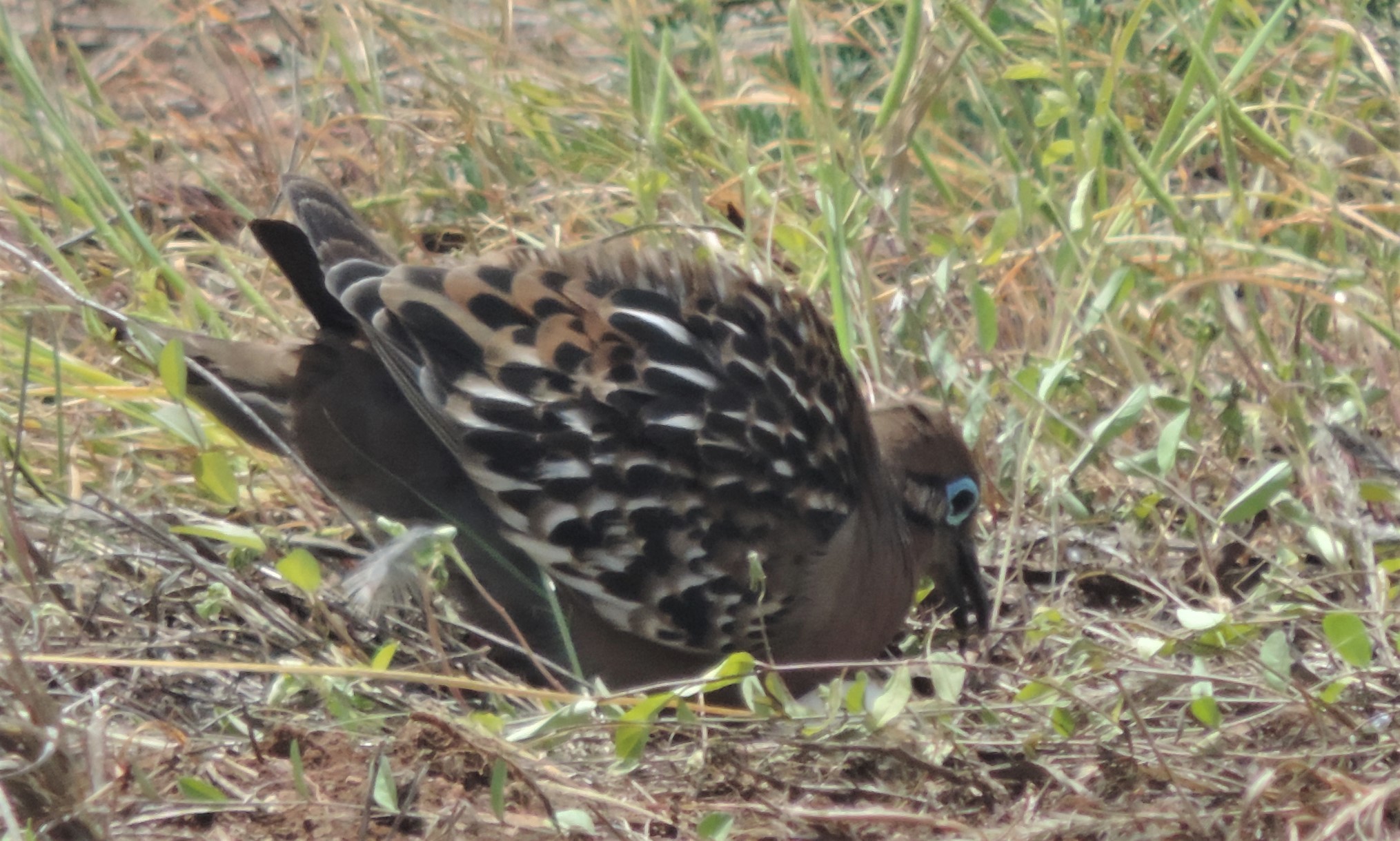
The Galápagos dove (Zenaida galapagoensis) is a species of bird in the family Columbidae. It is endemic to the Galápagos Islands. It is fairly common and is found in a wide range of open and semi-open habitats, especially in the arid lowlands of the archipelago.
Taxonomy and systematics
Two subspecies exist:
Zenaida galapagoensis galapagoensis (Gould, 1839) – the nominate subspecies. Found on the major islands of the Galapagos, with the exception of Darwin Island and Wolf Island.
Zenaida galapagoensis exsul (Rothschild & Hartert, 1899) – Slightly larger and darker than Z. g. galapagoensis. Found only on Darwin Island and Wolf Island.
Despite the geographic isolation of the bird on different islands, there is significant gene flow between the different island populations, owing to frequent migration between islands. This has not entirely prevented the formation of subspecies however, as environmental factors such as wind currents, distance between islands, and even ocean currents affect where birds travel. Yet their impressive flight ability has ensured that the species remains fairly homogenous across the islands, unlike the Galapagos hawk (which has significant variations in size by island), or the intense speciation found in the less mobile Darwin's finches. It is also possible that the dove's omnivorous diet has prevented greater specialization. The presence of humans may be prompting population genetic changes to the populations on San Cristóbal Island and Santa Cruz Island, which has led to decreased allelic diversity.
Description
Galapagos dove on Española Island
The Galápagos dove grows 18–23 cm (7.1–9.1 in) long and weighs in at 67–92 g (2.4–3.2 oz). The long black bill is slightly curved downwards. The feet and legs are reddish with some purple. A boldly marked bird, the Galápagos dove has dark reddish-brown upperparts, a pinkish neck and breast, a buff-coloured belly, and brown wings, streaked with white and black. The skin around the...