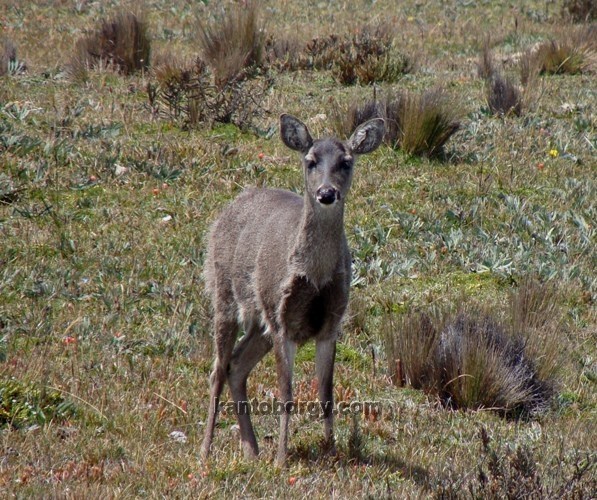
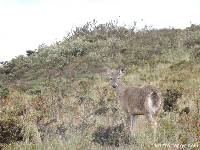
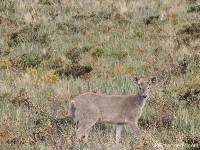
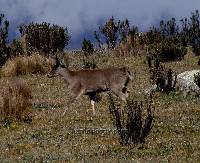
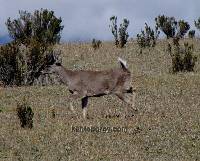
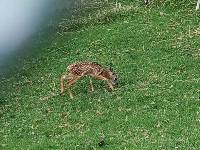
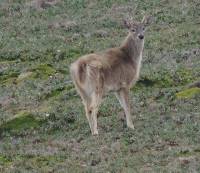
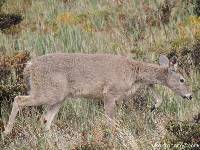
The white-tailed deer (Odocoileus virginianus), also known commonly as the whitetail and the Virginia deer, is a medium-sized species of deer native to North and South America. It is the most widely distributed mainland ungulate herbivore in the Americas; coupled with its natural predator, the mountain lion (Puma concolor), it is one of the most widely distributed terrestrial mammal species in the Americas and the world. Highly adaptable, the various subspecies of white-tailed deer inhabit many different ecosystems, from arid grasslands to the Amazon and Orinoco basins; from the Llanos to the high-elevation terrain of the Andes.
Distribution
In North America, the white-tailed deer is very common (even considered a nuisance in some areas) in states to the east and south of the Rocky Mountains, including southwestern Arizona, with the exception of the American West Coast and Baja California Peninsula, where its ecological niche is filled by the black-tailed deer (in the Pacific Northwest) or the mule deer (Odocoileus hemionus) from that point west except for mixed deciduous riparian corridors, river valley bottomlands, and lower foothills of the northern Rocky Mountain region from Wyoming west to eastern Washington and eastern Oregon, and north to northeastern British Columbia and southern Yukon, including in the Montana valley and foothill grasslands. The westernmost population of the species, known as the Columbian white-tailed deer, was once widespread in the mixed forests along the Willamette and Cowlitz River valleys of western Oregon and southwestern Washington, but current numbers are considerably reduced, and it is classified as near-threatened by the IUCN. This population is separated from other white-tailed deer populations.
Texas is home to by far the most individual white-tailed deer of all U.S. states, Canadian provinces, or Latin American countries, with an estimated population of 5.3 million, with both wild deer and farmed herds, the latter raised...