Carduus nutans is a biennial plant in the daisy and sunflower family Asteraceae with the common names musk thistle, nodding thistle, and nodding plumeless thistle. It is native to regions of Europe, Central Asia, and North Africa, where it is a scattered pasture plant. The musk thistle has been declared as invasive in North America, Australia, New Zealand, and South Africa.
Description
Carduus nutans is a monocarpic herb and is classified as a biennial thistle, though it can have varying phenology depending on climate and habitat. Mature plants can reach 2.7 m (9 ft) in height with multi-branched stems. The leaves are prickly and jagged and can reach up to 40 cm (1.3 ft) in length. The leaves are dark green, coarsely bipinnately lobed, with a smooth, waxy surface and sharp yellow-brown to whitish spines at the tips of the lobes. They are more or less hairy on top, and wooly on the veins below. The stem is cottony/hairy, with thin ribs along them. The plants develop a rosette, with large leaves up to about 40 centimetres (16 inches) long. The seeds are able to germinate between 15 and 30 °C (59 and 86 °F), thriving in conditions that offer moist soil and an alternating day/night temperature. A single plant is able to produce around 100 seeds per flower, up to about 20,000 seeds per plant. Seeds are mainly wind dispersed and can survive in the soil seed bank for up to 20 years.
Flower head
Blooming in grassland habitat
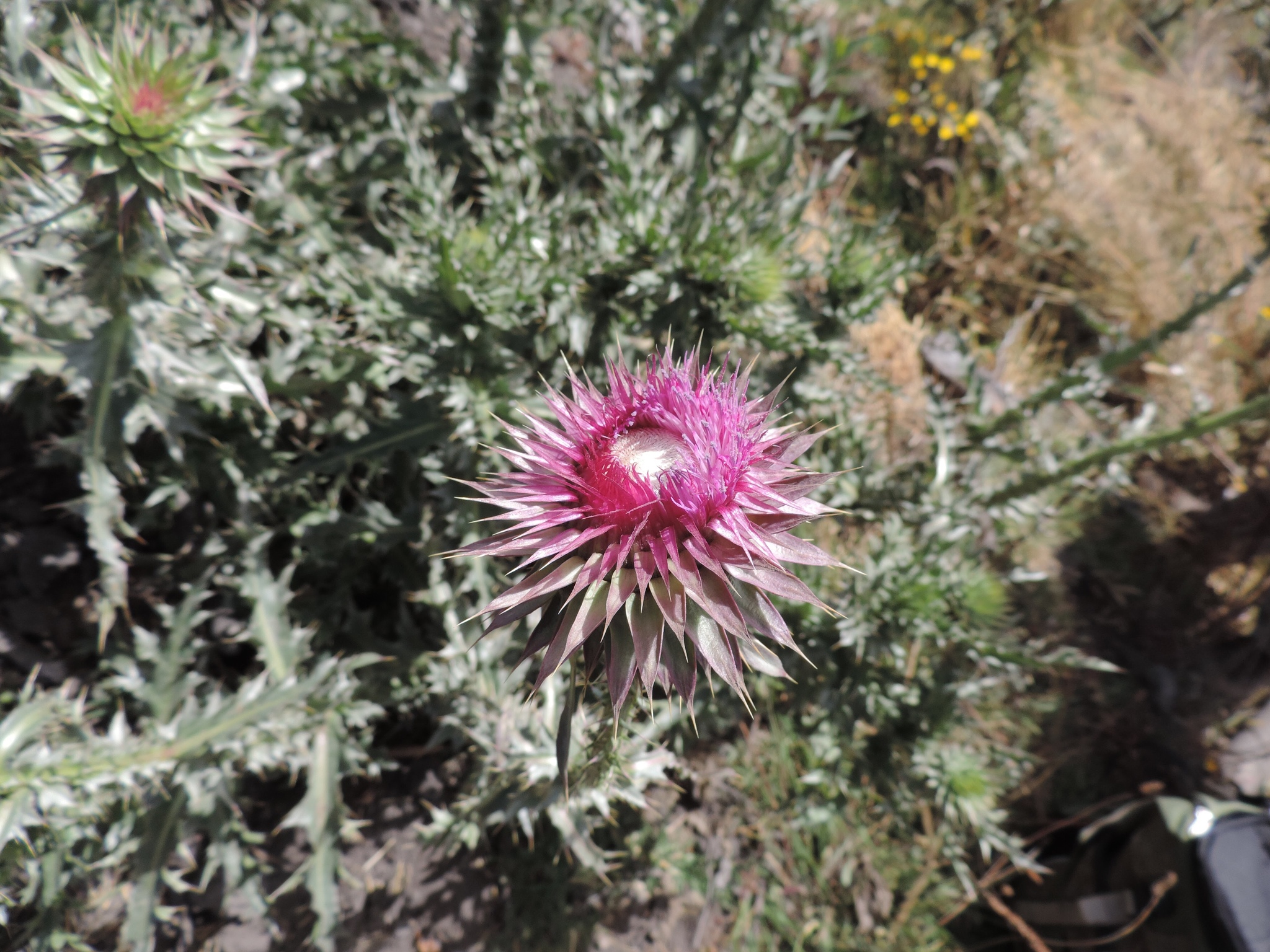
The plant bears showy flowers that range from a deep rose to violet color, rarely white. The large globose flower heads, containing hundreds of tiny individual flowers, are
The number of flower heads per plant is site-dependent and ranges from about 20–50 on good sites and 1–20 on poor sites. Flowering occurs from June to October, and seed dissemination occurs approximately one month after the flowers form.