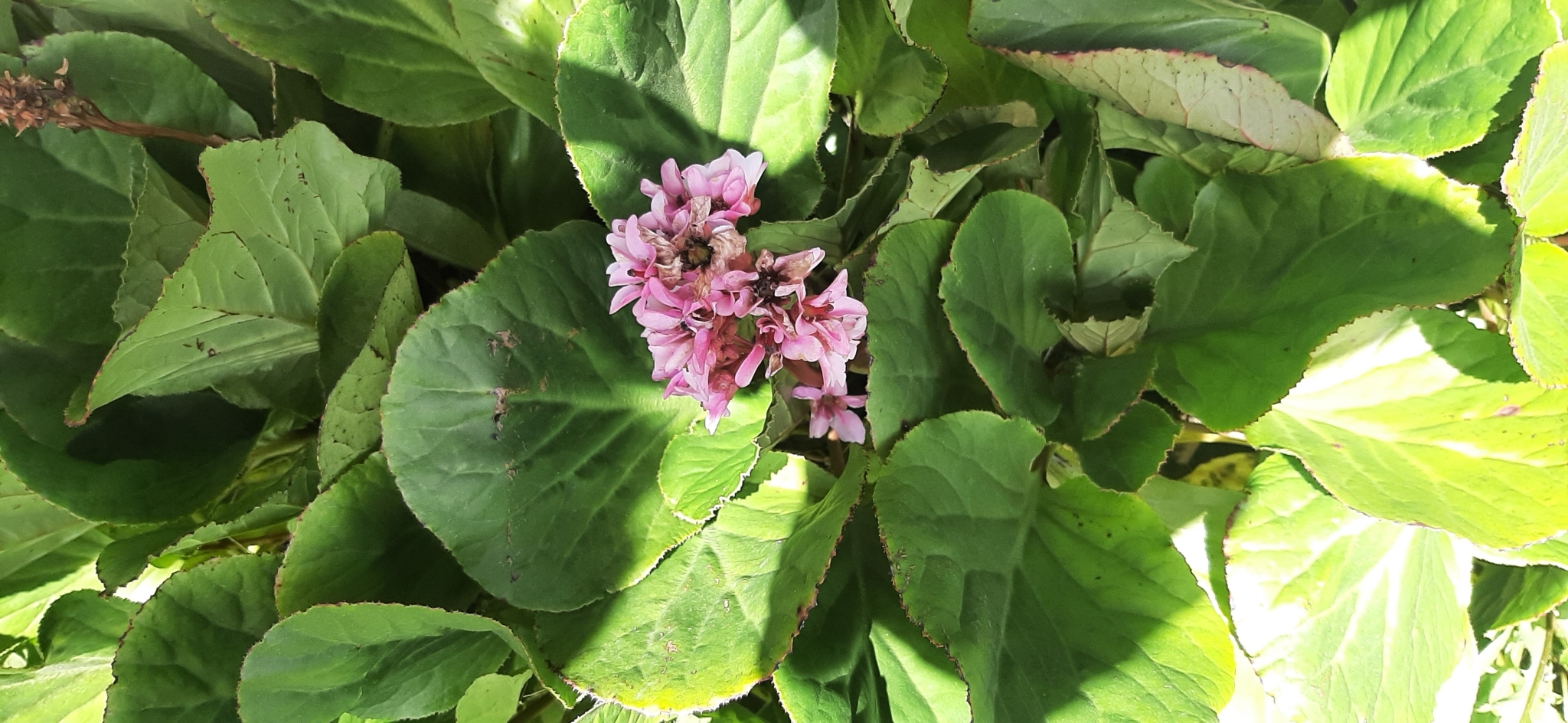
Bergenia (elephant-eared saxifrage, elephant's ears) is a genus of ten species of flowering plants in the family Saxifragaceae, native to central Asia, from Afghanistan to China and the Himalayan region.
Description
They are clump-forming, rhizomatous, evergreen perennials with a spirally arranged rosette of leaves 6–35 cm (2.4–13.8 in) long and 4–15 cm (1.6–5.9 in) broad, and pink flowers produced in a cyme. The leaves are large, leathery, ovate or cordate, and often have wavy or saw-toothed edges. For most of the year, the leaves have a glossy green colour, but in cooler climates, they turn red or bronze in the fall. The flowers grow on a stem similar in colour to a rhubarb stalk and most varieties have cone-shaped flowers in varying shades of pink. These can range from almost white to ruby red and purple.
The common names for Bergenia are pigsqueak (due to the sound produced when two leaves are rubbed together), elephant's ears (due to the shape of the leaves) and large rockfoil.
Bergenia is closely related to Mukdenia, Oresitrophe, Astilboides and Rodgersia.
The creator of the taxonomic genus name, Conrad Moench, honoured the German botanist and physician Karl August von Bergen by coining the name Bergenia in 1794.
Species
Fruit of Bergenia cordifolia
10 species are accepted.
Bergenia ciliata (Haw.) Sternb. – western Himalayas to southwestern Nepal. Has cultivar Bergenia ciliata 'Superba'.
Bergenia crassifolia (L.) Fritsch (syn. Bergenia cordifolia) – Kazakhstan and western Siberia to Mongolia, the Russian Far East, and Korea. The most widely grown garden plant, especially the cultivar Bergenia cordifolia 'Purpurea.' The species epithet crassifolia means thick-leaved, and cordifolia means cordate (heart-shaped) leaf (although the leaves may also be described as spoon-shaped). It grows to about 30 cm (12 in) tall. The leaves are winter hardy and change color in the range of rust brown to brown-red....