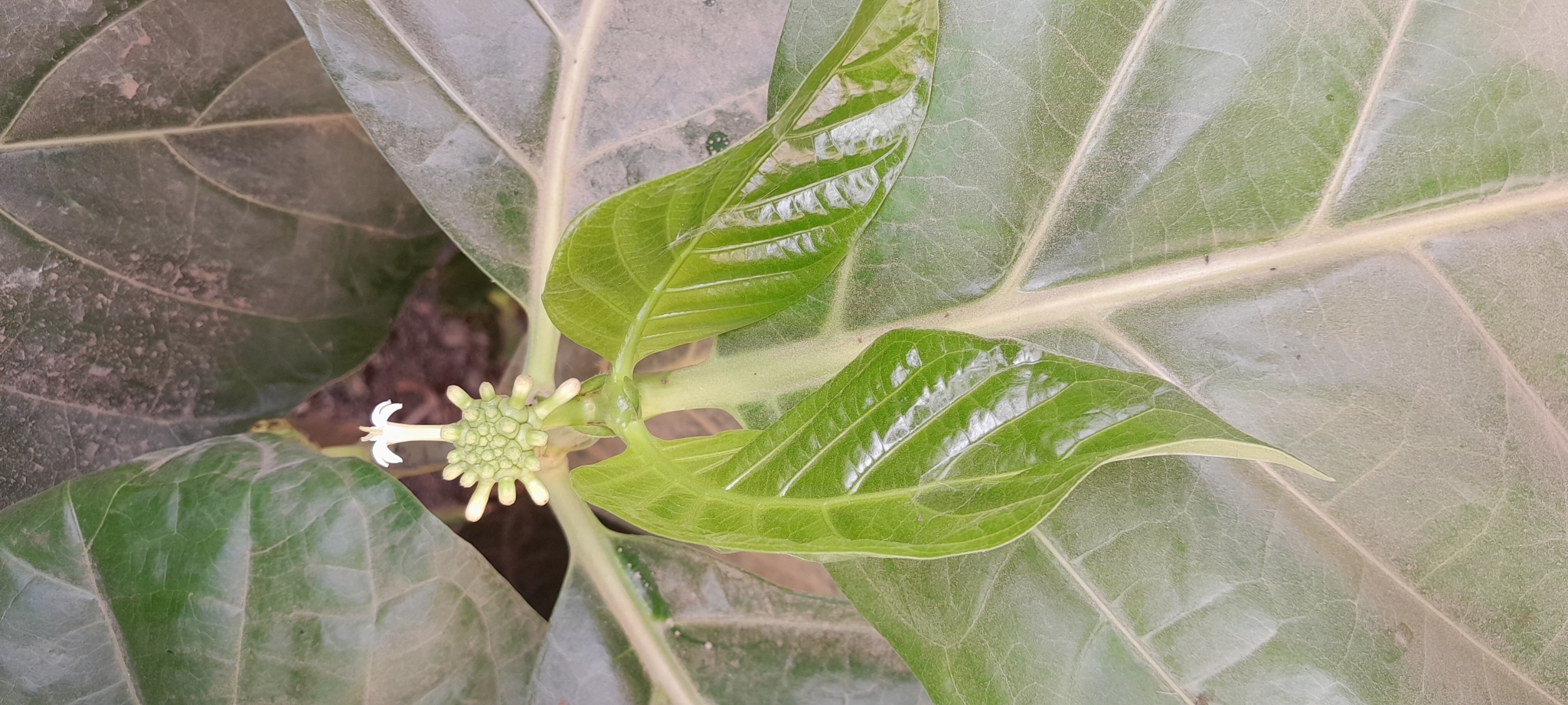
Morinda citrifolia is a fruit-bearing tree in the coffee family, Rubiaceae. It is commonly known as noni or Indian mulberry, among many other names.
Native to Southeast Asia and Australasia, the species was spread across the Pacific by Polynesian sailors. It is now cultivated throughout the tropics and is widely naturalised.
The plant contains anthraquinones, which can be harmful to human health. Although the fresh fruit is edible, its pungent odour makes it worthwhile only as a famine food. It is also used in traditional medicine and processed into products such as juices.
Description
Fruit in cross-section
Morinda citrifolia is a shrub or small tree up to
The inflorescences are dense heads of flowers produced at the apex of the branch. They are leaf-opposed, replacing one leaf in the pair. There may be up to 90–100 flowers in the head, but only a few open at a time. The flowers are white and tubular with five lobes, measuring about 15 cm long and across.
The fruit is a multiple fruit consisting of fused drupes, each containing four seeds. They are initially green, transitioning through pale yellow to white or grey, and when ripe they emit a pungent odour similar to blue cheese. They are irregularly ellipsoid or ovoid, and may reach up to 9x6 cm.
The plants flower and fruit throughout the year. It is common to see flowers and fruit in varying stages of development on a plant at any given time.
Morinda citrifolia fruit contains diverse phytochemicals, including anthraquinones, lignans, oligo- and polysaccharides, flavonoids, iridoids, such as deacetylasperulosidic acid, fatty acids, scopoletin, catechin, beta-sitosterol, damnacanthal, and alkaloids.
Phenology
The plants flower and fruit throughout the year. It is common to see flowers and fruit in varying stages of development on a plant at any given time.
Chemistry
Morinda citrifolia fruit contains diverse phytochemicals, including anthraquinones, lignans, oligo- and polysaccharides,...