Prunus serotina, commonly called black cherry, wild black cherry, rum cherry, or mountain black cherry, is a New World deciduous tree or shrub in the rose family, Rosaceae. Despite its common names, it is not very closely related to commonly cultivated cherries.
Description
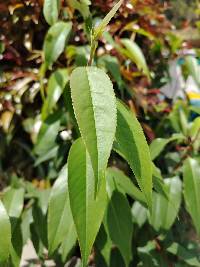
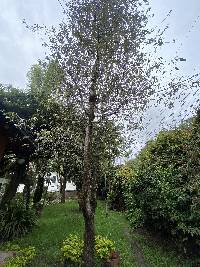
Prunus serotina is a medium-sized, fast-growing deciduous forest tree or shrub growing to a height of 15–24 metres (49–79 feet). The leaves are 5–13 centimetres (2–5 inches) long, ovate-lanceolate in shape, with finely toothed margins. The fall leaf color is yellow to red. The flowers are small, white and 5-petalled, in racemes 10–15 cm (4–6 in) long which contain several dozen flowers. The flowers give rise to reddish-black "berries" (drupes) fed on by birds,
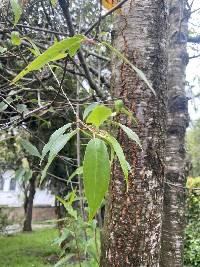
For about its first decade the bark of a black cherry tree is thin, smooth, and banded, resembling a birch. A mature tree has very broken, dark gray to black bark. The leaves are long and shiny, resembling a sourwood's. An almond-like odour is released when a young twig is scratched and held close to the nose, revealing minute amounts of cyanide compounds produced and stored by the plant as a defense mechanism against herbivores.
@media all and (max-width:720px){
Young bark
Mature bark
Flower clusters
Immature fruit
Autumn foliage
Like apricots and apples, the seeds of black cherries contain cyanogenic glycosides (compounds that can be converted into cyanide), such as amygdalin. These compounds release hydrogen cyanide when the seed is ground or minced, which releases enzymes that break down the compounds. These enzymes include amygdalin beta-glucosidase, prunasin beta-glucosidase and mandelonitrile lyase. In contrast, although the flesh of black cherries also contains these glycosides, it does not contain the enzymes needed to convert them to cyanide, so the flesh is safe to eat.
The foliage, particularly when wilted, also contains...