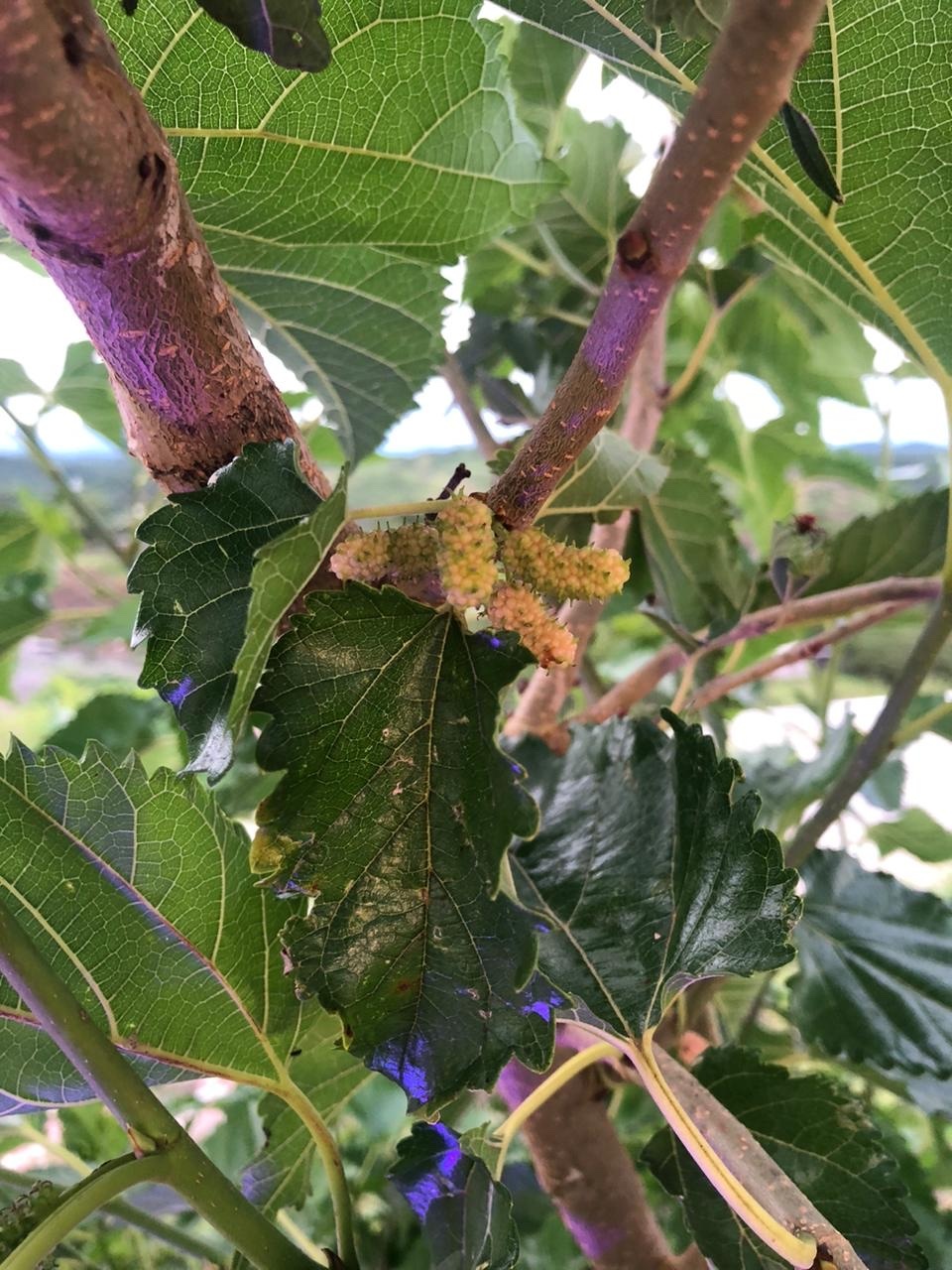
Morus alba, known as white mulberry, common mulberry and silkworm mulberry, is a fast-growing, small to medium-sized mulberry tree which grows to 10–20 m (33–66 ft) tall. It is native to China and is widely cultivated and naturalized elsewhere. The species is widely cultivated to feed the silkworms employed in the commercial production of silk. It is also notable for the rapid release of its pollen, which is launched at greater than half the speed of sound.
The specific Latin epithet alba refers to white.
Description
Leaves and fruit
The tree can grow to 15 metres (50 ft) tall. It is generally a short-lived tree with a lifespan comparable to that of humans, although there are some specimens known to be more than 250 years old. Generally, the trees are deciduous in temperate regions, but trees grown in tropical regions may be evergreen. On young, vigorous shoots, the leaves may be up to 30 cm (12 in) long, and deeply and intricately lobed, with the lobes rounded. On mature trees, the leaves are generally 5–13 cm (2–5 in) long, unlobed, cordate at the base and rounded to acuminate at the tip, and serrated on the margins.
The flowers are single-sex catkins; male catkins are
The white mulberry is scientifically notable for the rapid plant movement involved in pollen release from its catkins. The stamens act as catapults, releasing stored elastic energy in just 25 μs. The resulting movement is approximately 380 miles per hour (610 km/h), about half the speed of sound, making it the fastest known movement in the plant kingdom.