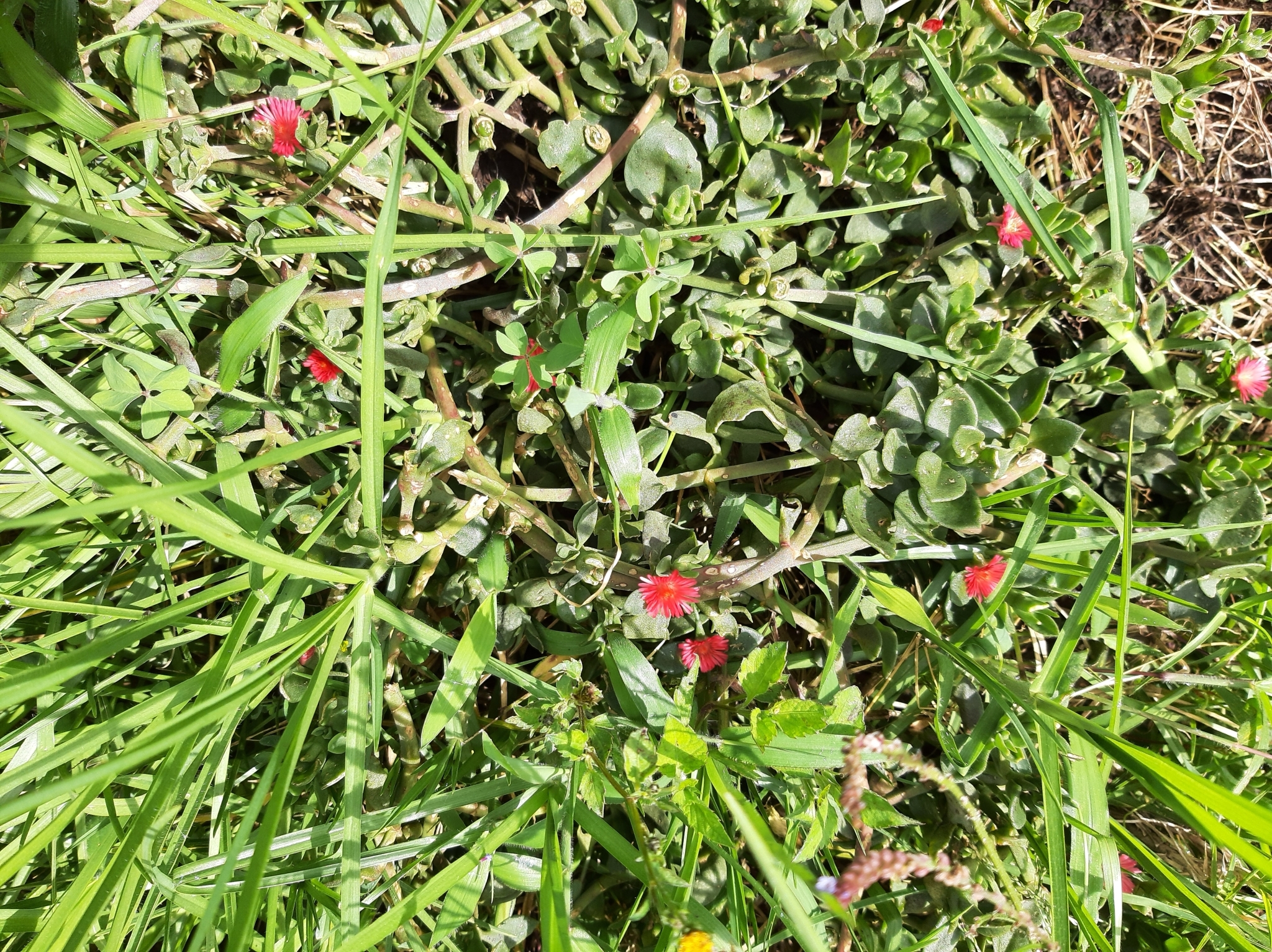
Mesembryanthemum is a genus of flowering plants in the family Aizoaceae, indigenous to southern Africa. As with many members of that family, it is characterized by long-lasting flower heads. Flowers of Mesembryanthemum protect close at night-time but open in sunlight. Where sun, dew, frost, wind or predators are likely to damage exposed reproductive organs, closing may be advantageous during times when flowers are unlikely to attract pollinators.
Many Mesembryanthemum species are known as ice plants because of the glistening globular bladder cells covering their stems, fruit and leaves, "... they sparkle like ice crystals". In South Africa, Mesembryanthemums are known as "vygies" (from Afrikaans "vy"), although that term refers to many plants in the family Aizoaceae.
Species formerly placed in Mesembryanthemum have been transferred to other genera, such as Cleretum and Carpobrotus, although sources differ.
Etymology
Jacob Breyne coined the name of the flower in 1684, using the spelling Mesembrianthemum ("midday flower"), from the Greek roots μεσημβρία, meaning "noon", and ἄνθεμον, meaning "flower", because the species known in his time flowered at midday. In 1719, with the discovery that some species flowered at night, Johann Jacob Dillenius changed the spelling to Mesembryanthemum ("flower with the pistil in the center"), rederiving the first part of the word from Greek μεσος ("middle") and ἔμβρυον ("pistil" or "embryo"). Carl Linnaeus used the Dillenius spelling (with the "y") in his description of the Mesembryanthemum species and the International Code of Botanical Nomenclature requires the retention of the original, deliberate spelling.
Description
Raphides are found in abundance in this genus.
Uses
Mesembryanthemums are often cultivated as ornamental plants for their showy flowers. Ornamental plants may escape into the wild and consequently have become widely naturalized outside their native range. They are considered an invasive weed in...