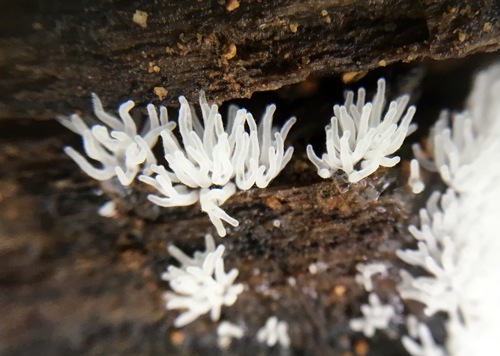
Ceratiomyxa is a genus of plasmodial slime mould within the Eumycetozoa, first described by Pier Antonio Micheli. They are widely distributed and commonly found on decaying wood.
The plasmodium often appears as white frost-like growth or thin watery layers on wood. Pillar or wall-like sporangia bud from the plasmodium and develop spores that undergo multiple divisions before they release flagellated zoospores. The zoospores will then pair off, undergo plasmogamy, and form zygotes that will later form new plasmodia.
The genus currently contains four species. The most notable member is Ceratiomyxa fruticulosa, a slime mould found in most parts of the world. Other known species of Ceratiomyxa are mostly found in the tropics
The genus is, by area, the largest macroscopic slime mold known that is not a part of the myxogastria; and is thus the largest protosteloid.
Etymology
Ceratiomyxa comes from the Latin word ceratus meaning "waxed" and the ancient Greek word myxa meaning "mucus".
History of knowledge
Ceratiomyxa was first described under the name Puccinia ramose (later revised to Ceratiomyxa fruticulosa) in 1729 by Pier Antonio Micheli, a pioneer of mycology. In 1805, Albertini and Schweinitz described 2 more species in the genus, C. hydnoides and C. porioides. However, because Ceratiomyxa species can take a variety of different forms, many forms first described as species are later considered synonyms. This includes C. hydnoideum and C. porioides which are now often considered synonyms of C. fruticulosa. However, phylogenetic analyses have shown C. porioides should be considered a distinct species.
Ceratiomyxa was first placed in the subclass Ceratiomyxomycetidae of the class Myxomycetes by Martin and Alexopoulos in 1969, but was later moved to subclass Protostelia of the class Eumycetozoa by Olive in 1970.
Habitat and ecology
Ceratiomyxa is commonly found on rotting wood. Large logs and stumps are cited as ideal substrates for growth, although smaller colonies can also be found on tree...