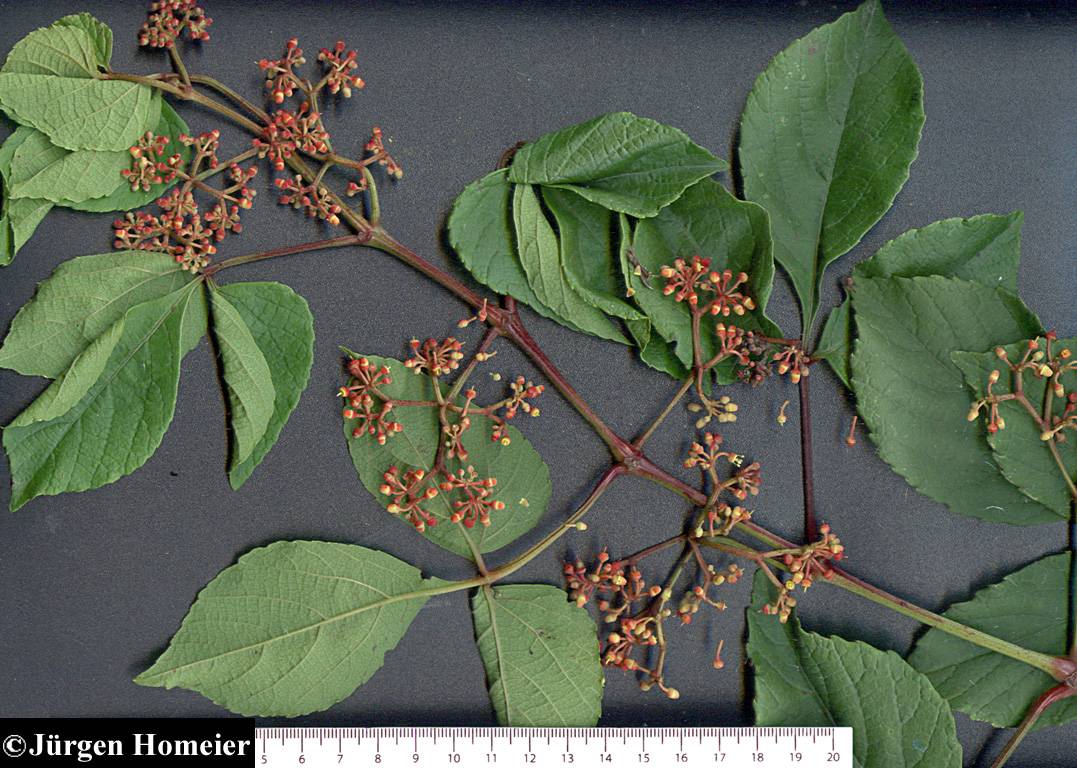
The Vitaceae, also called the grape family, is a family of flowering plants that has 20 genera and around 910 known species in its monotypic order Vitales, including common plants such as grapevines (Vitis spp.) and Virginia creeper (Parthenocissus quinquefolia). The family name is derived from the genus Vitis.
Most of its members are distributed in tropical areas and many are dominant climbers with ecological significance, but some could be shrubs or tree. Some species of genus Tetrastigma serve as hosts to parasitic plants in another family Rafflesiaceae. Some produce pearl bodies that may be a defense trait and a food source for arthropods.
In general, members of Vitaceae show a high variety in their chromosome number. The numbers could be used to differentiate species, but the differences in numbers can also make it difficult to hybridize.
The family is economically important as the berries of Vitis species, commonly known as grapes, are an important fruit crop and, when fermented, produce wine.
The extant species of Vitaceae are widespread and so is the fossil record.
Description
Members of Vitaceae are usually climbers with tendrils opposite to their leaves, and they are considered as the most successful climbers among tropical and temperate vegetation. Vitaceae range from vines, lianas (woody vines), to occasionally shrubs or trees and can be succulent. The fruit of Vitaceae is berry. Their leaves are arranged alternately, in simple or compound type, and leave margins are toothed to lobed.
Some species of genus Tetrastigma, such as T. diepenhorstii (Miq.) Latiff and T. rafflesiae, are the hosts of parasitic plants in genus Rafflesia, which belongs to family Rafflesiaceae.
Pearl bodies, or food bodies, are microscopic orbs mostly found on leaves or stems occurred in a variety of plant families, as well as many Vitaceae genera and species, like Cissus and Vitis. Pearl body is often described as a part of the defense mechanism and a source of...