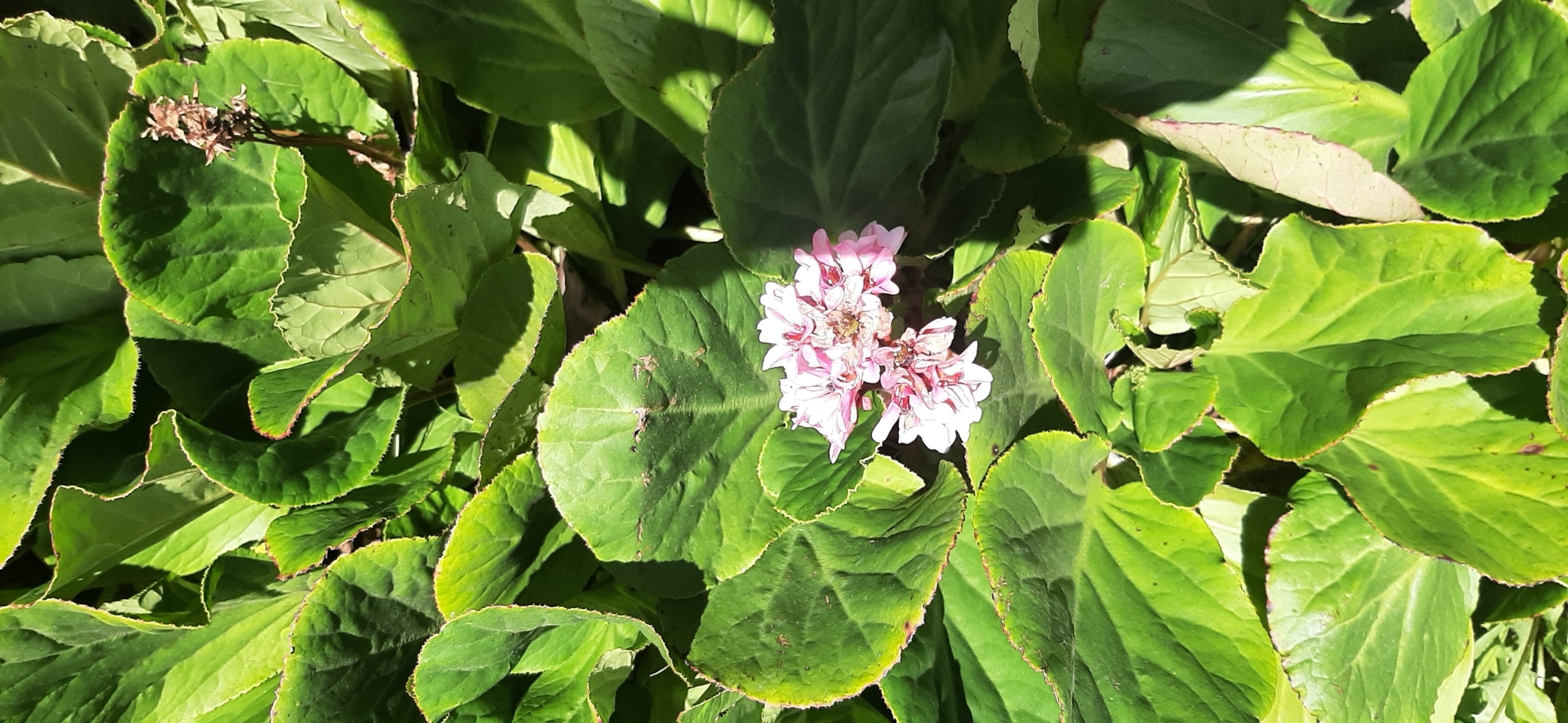
Saxifragaceae is a family of herbaceous perennial flowering plants, within the core eudicot order Saxifragales. The taxonomy of the family has been greatly revised and the scope much reduced in the era of molecular phylogenetic analysis. The family is divided into ten clades, with about 640 known species in about 35 accepted genera. About half of these consist of a single species, but about 400 of the species are in the type genus Saxifraga. The family is predominantly distributed in the northern hemisphere, but also in the Andes in South America.
Description
Species are herbaceous perennials (rarely annual or biennial), sometimes succulent or xerophytic, often with perennating rhizomes. The leaves are usually basally aggregated in alternate rosettes, sometimes on inflorescence stems. They are usually simple, rarely pinnately or palmately compound. Their margins may be entire, deeply lobed, cleft, crenate or dentate and petiolate with stipules.
The inflorescences are bracteate racemes or cymes. The flowers are hermaphroditic (bisexual), rarely unisexual (androdioecious), actinomorphic (rarely zygomorphic). The perianth is placed on a hypanthium that may be free or may be partly fused with the ovary (which is then semi-inferior). There are usually five sepals, but there may be three to ten, fused with the hypanthium, occasionally petaloid. The petals are clawed, sometimes cleft at the tip or finely dissected. Flowers have five to ten stamens, free and opposite the petals, with the anthers usually basifixed and opening by lengthwise slits. The ovary is inferior to semi-inferior with two (sometimes three) carpels usually fused at the base, sometimes free, each topped with stylodium and capitate stigma. The ovules are few to many, with axile or parietal placentation and two to three styles. The fruit is usually a septicidal capsule or follicle, with numerous small seeds.
Taxonomy
Saxifragaceae has long been considered in a pivotal position in the evolution of angiosperm...