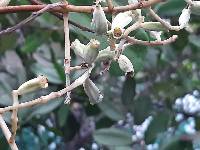
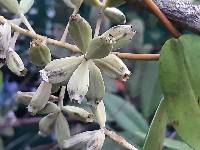
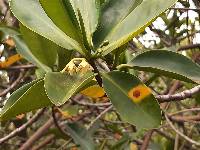
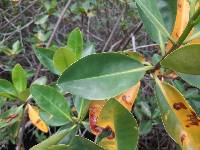
Rhizophora mangle, also known as the red mangrove, is a salt-tolerant, small-to-medium sized evergreen tree restricted to coastal, estuarine ecosystems along the southern portions of North America, the Caribbean as well as Central America and tropical West Africa. Its viviparous "seeds", in actuality called propagules, become fully mature plants before dropping off the parent tree. These are dispersed by water until eventually embedding in the shallows.
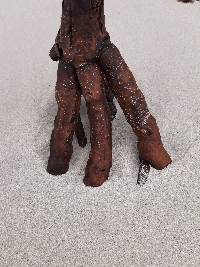
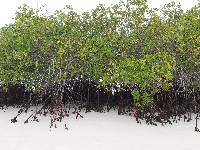
Rhizophora mangle grows on aerial prop roots, which arch above the water level, giving stands of this tree the characteristic "mangrove" appearance. It is a valuable plant in Florida, Louisiana, and Texas coastal ecosystems. The name refers to the red colour on the inner part of its roots when halved, so it does not display any red colour in its regular appearance. In its native habitat it is threatened by invasive species such as the Brazilian pepper tree (Schinus terebinthifolia). The red mangrove itself is considered an invasive species in some locations, such as Hawaii, where it forms dense, monospecific thickets. R. mangle thickets, however, provide nesting and hunting habitat for a diverse array of organisms, including fish, birds, and crocodiles.
Description
Red mangroves are easily distinguishable through their unique prop roots system and viviparous seeds. The prop roots of a red mangrove suspend it over the water, thereby giving it extra support and protection. They also help the tree to combat hypoxia by allowing it a direct intake of oxygen through its root structure.
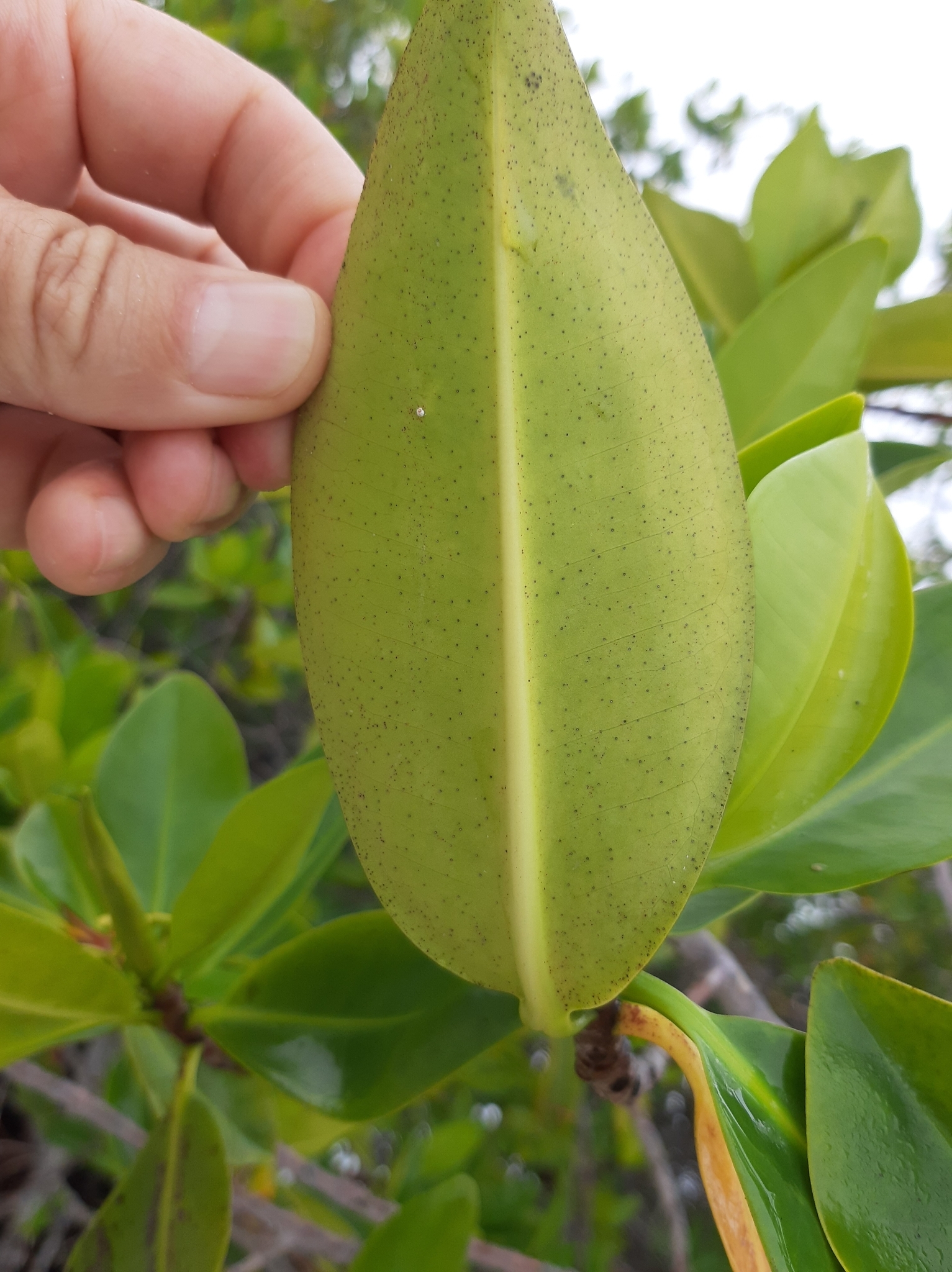
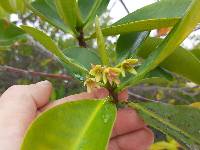
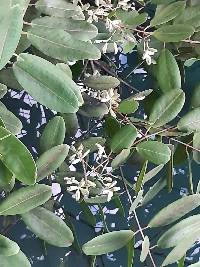
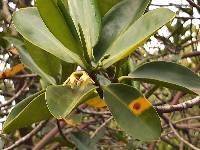
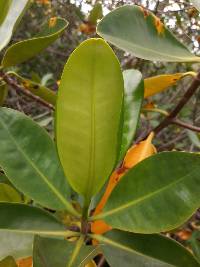
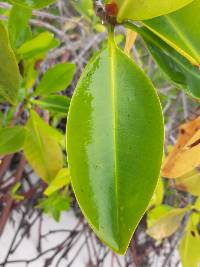
A mangrove can reach up to 80 ft (24 m) in height in ideal conditions, but it is commonly found at a more modest 20 ft (6.1 m). Its bark is thick and a grey-brown color. Mangrove leaves are 1–2 in (2.5–5.1 cm) wide and 3–5 in (7.6–12.7 cm) long, with smooth margins and an elliptical shape. They are a darker shade of green on the tops than on the bottoms. The tree produces yellow flowers in the...