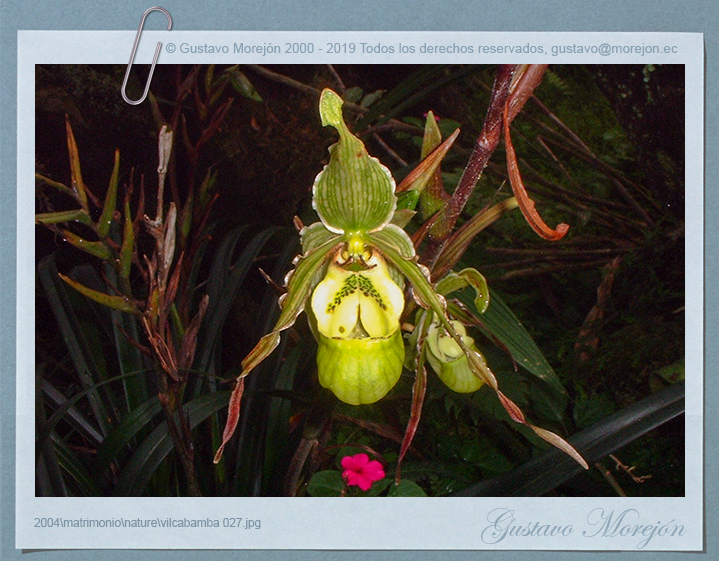
Phragmipedium is a genus of the Orchid family (Orchidaceae) (Subfamily Cypripedioideae) and the only genus comprised in the tribe Phragmipedieae and subtribe Phragmipediinae. The name of the genus is derived from the Greek phragma, which means "division", and pedium, which means "slipper" (referring to the pouch). It is abbreviated 'Phrag' in trade journals.
About 20 species of these lady's slipper orchids are known from SW Mexico, Central and tropical South America.
All Phragmipedium species are listed under Appendix I of the Convention on International Trade in Endangered Species (CITES), meaning that commercial international trade in wild-sourced specimens is prohibited, while non-commercial trade is regulated.
Taxonomy
Phragmipedium "les dirouilles" cultivar
The genus Phragmipedium is divided into several sections:
Phragmipedium: P. caudatum, P. exstaminodium, P. lindenii
Himantopetalum: P. caricinum, P. christiansenianum, P. pearcei, P. klotzscheanum, P. richteri, P. tetzlaffianum
Platypetalum: P. lindleyanum
Lorifolia: P. boissierianum, P. hirtzii, P. longifolium, P. vittatum
Micropetalum: P. besseae, P. besseae var. dalessandroi, P. fischeri, P. schlimii
Schluckebieria: P. kovachii
The exact number of species is still being discussed among specialists: O. Gruss recognizes 20 species, compared to the 15 species accepted by Lucile M. McCook (see References).
Most Phragmipedium species are either terrestrial, epiphytic or lithophytic in habit. They show a unique shieldlike staminode, long, moustache-like petals and a 3-locular ovary. The large pouchlike lip is curved inwards at the margins. The acute leaves attain a length of about 80 cm. The stem lacks pseudobulbs and grows about 80 cm (31 in) high, showing 2 to 3 flowers.
Phragmipedium besseae was first found in Peru by Elizabeth Locke Besse in 1981. Soon afterwards, the site was plundered and destroyed by orchid hunters. Seed was preserved to avert extinction. This orchid is...