Caesalpinia pulcherrima is a species of flowering plant in the pea family Fabaceae, native to the tropics and subtropics of the Americas. It could be native to Central America, but its exact origin is unknown due to widespread cultivation. Common names for this species include poinciana, peacock flower, red bird of paradise, Mexican bird of paradise, dwarf poinciana, pride of Barbados, flos pavonis, and flamboyant-de-jardin.
Description
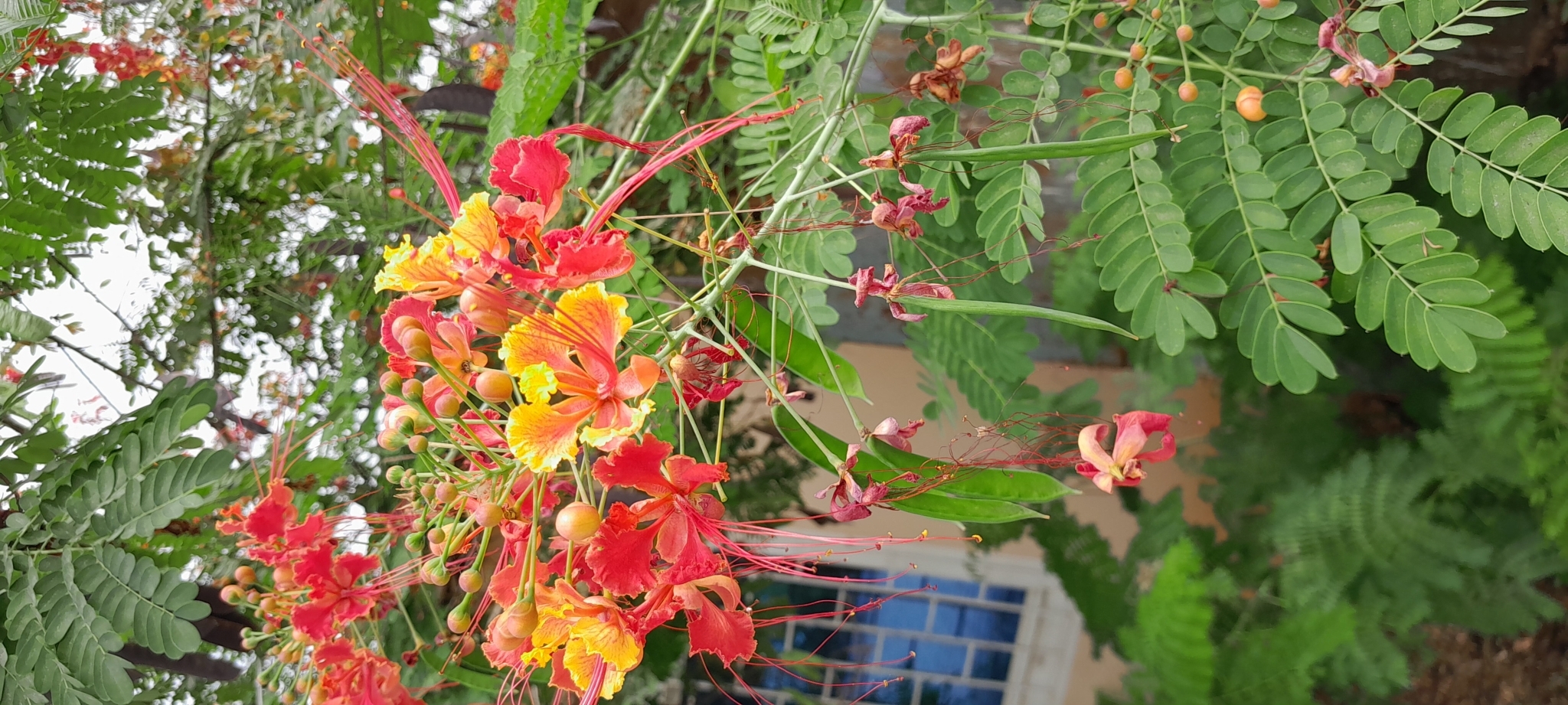
Flowers at various stages of blooming
It is a shrub growing to 3 m tall. In climates with few to no frosts, this plant will grow larger and is semievergreen. In Hawaii this plant is evergreen and grows over 5 m tall. Grown in climates with light to moderate freezing, it will die back to the ground during the winter, but will rebound in mid- to late spring. This species is more sensitive to cold than others.
The leaves are bipinnate, 20–40 cm long, bearing three to 10 pairs of pinnae, each with six to 10 pairs of leaflets 15–25 mm long and 10–15 mm broad. The flowers are borne in racemes up to 20 cm long, each flower with five yellow, orange, or red petals. The fruit is a pod 6–12 cm long.
Taxonomy
Poinciana pulcherrima is a synonym of Caesalpinia pulcherrima.
Symbolism
Caesalpinia pulcherrima is the national flower of the Caribbean island of Barbados, and is depicted on the upper left and right corners of the Queen Elizabeth II's personal Barbadian flag.
Uses
All seeds of Caesalpinia are poisonous. However, the seeds of some species are edible before they reach maturity (e.g. immature seeds of C. pulcherrima) or after treatment (e.g. C. bonduc after roasting).
Maria Sibylla Merian, a 17th-century artist, encountered this plant in the Dutch colony of Surinam. In her work, Metamorphosis insectorum Surinamensium, Merian recorded that African slaves and native Indian populations used the flos pavonis or peacock flower as an abortifacient in their practice of traditional medicine. She wrote:...