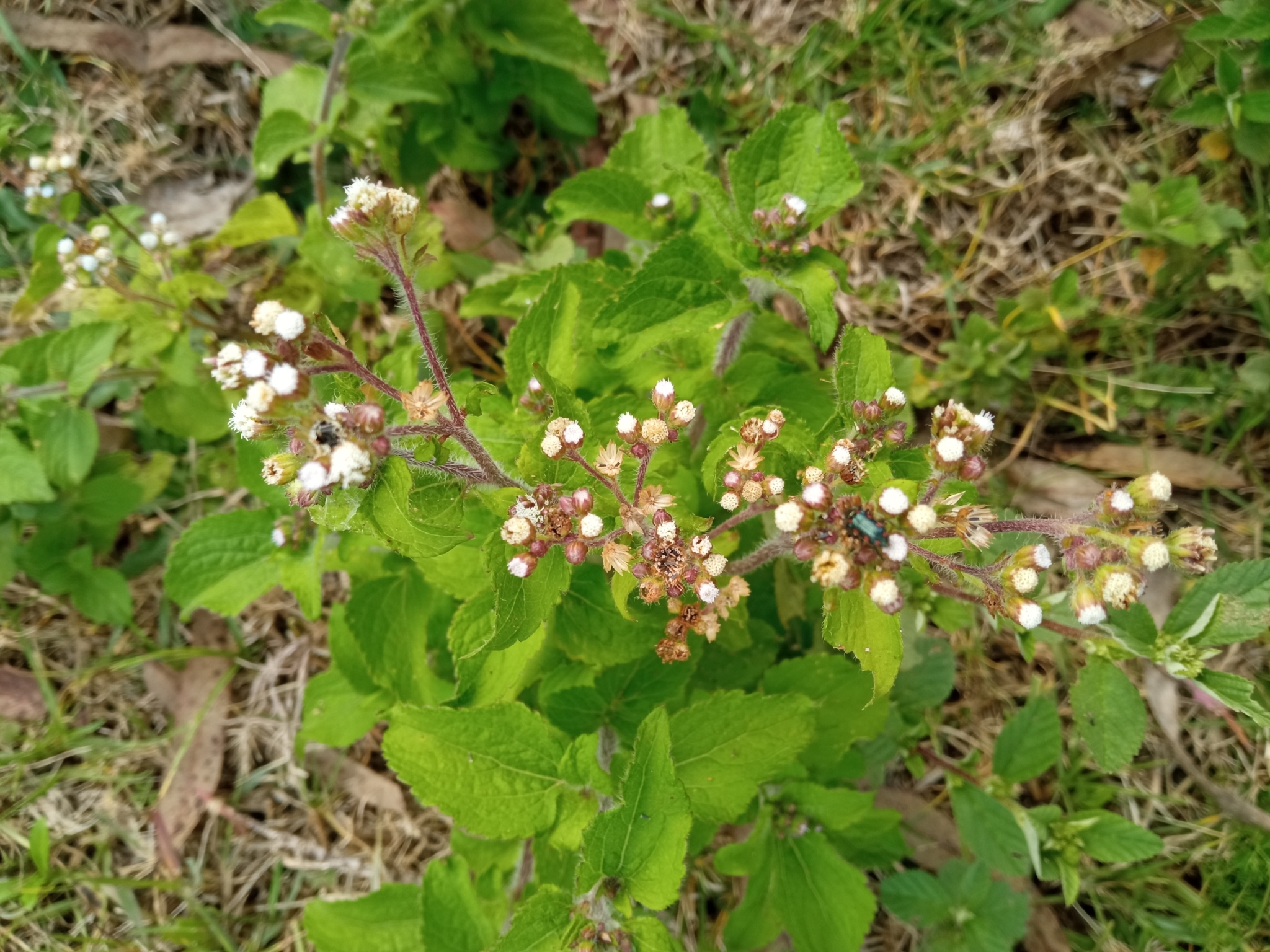
Ageratum () (whiteweed in the US) is a genus of 40 to 60 tropical and warm temperate flowering annuals and perennials from the family Asteraceae, tribe Eupatorieae. Most species are native to Central America and Mexico but four are native to the United States.
They form tussocks or small mounds. They grow to a height of 30 inches (76 cm). The opposite leaves are cordate or oval, hairy or tomentose. The margins are slightly toothed or serrate. The leaves form compact clusters.
The fluffy flowers are lavender-blue, pink, lilac, or white, and spread in small compound umbels. They give small, dry fruits.
Cultivation
Ageratums are grown for their flowers, especially A. houstonianum.
Most common ageratums, "Hawaii" for example, are a short 6–8 inches (15–20 cm) when full grown. Tall ageratum are also available in seed catalogues. They are about 18 inches (46 cm) in height with blue flowers. There is also a medium-height snowcapped variety, white top on blue flowers. The blues are most popular and common, but colors also include violet, pink and white. Their size and color makes ageratums good candidates for rock gardens, bedding, and containers. They grow well in sun or partial shade, from early summer to first frost. They are quite easy to grow, producing a profusion of fluffy flowers all season long.
Toxicity
Several species of Ageratum are toxic, containing pyrrolizidine alkaloids. Ageratum houstonianum and Ageratum conyzoides cause liver lesions and are tumorigenic.
Weed risk
Ageratum conyzoides and Ageratum houstonianum are prone to becoming rampant environmental weeds when grown outside of their natural range.
Species
As of July 2020, Plants of the World online has 40 accepted species: