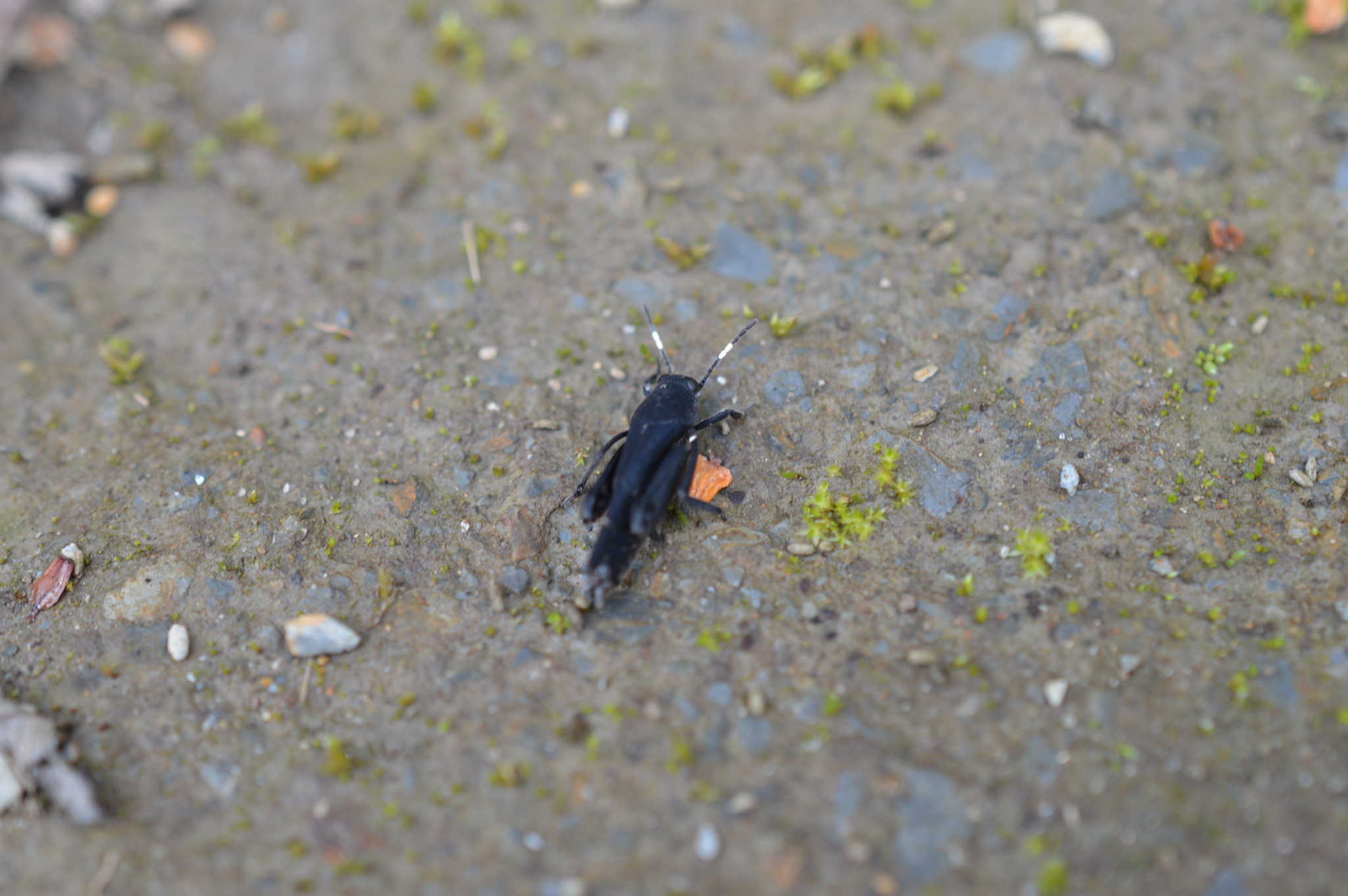
Ripipterygidae is a family of insects in the order Orthoptera. Members of the family are commonly known as mud crickets.
Description
Ripipteryx sp. (possibly R. biolleyi), Cartago, Costa Rica
Ripipterygids are small, often dark-colored, cricket-like orthopterans, between 3 and 14 mm in length. They closely resemble the related tridactylids. Like tridactylids, they have greatly expanded hind femora, and have the ability to swim and jump from the surface of water. They can be distinguished from tridactylids by their uninflated tibiae on the middle pair of legs, unsegmented cerci, rows of comblike teeth on the epiproct, and setae at the tips of the cerciform lobes on the paraproct, as well as through characters of the genitalia.
Species in the genus Ripipteryx are typically black or dark brown and often metallic; many are boldly colored or strikingly patterned, with sharply contrasting white, yellow, and/or red markings. Members of the genus Mirhipipteryx are typically smaller and more drably colored.
Distribution and habitat
Ripipteryx limbata, Cartago, Costa Rica
Ripipterygids are restricted to the Neotropics. They can be found from southern Mexico south to central South America. Like tridactylids, they are typically found in riparian areas, on bare soil, sand, and mud, as well as on rocks, and – in some species – low vegetation in, near, or above water. In at least some species, individuals are not distributed evenly throughout appropriate habitat, but rather are found in groups.
Biology
Ripipterygids have been comparatively little-studied, and many aspects of their biology are poorly known, with behavioral observations having only been made on a handful of species.
Like tridactylids, ripipterygids walk quadrupedally using only their first two pairs of legs, and the hind legs are only used for jumping and swimming. Ripipterygids fly when disturbed, often landing on water and swimming back to shore.
Ripipterygids are herbivorous, and have been recorded feeding...