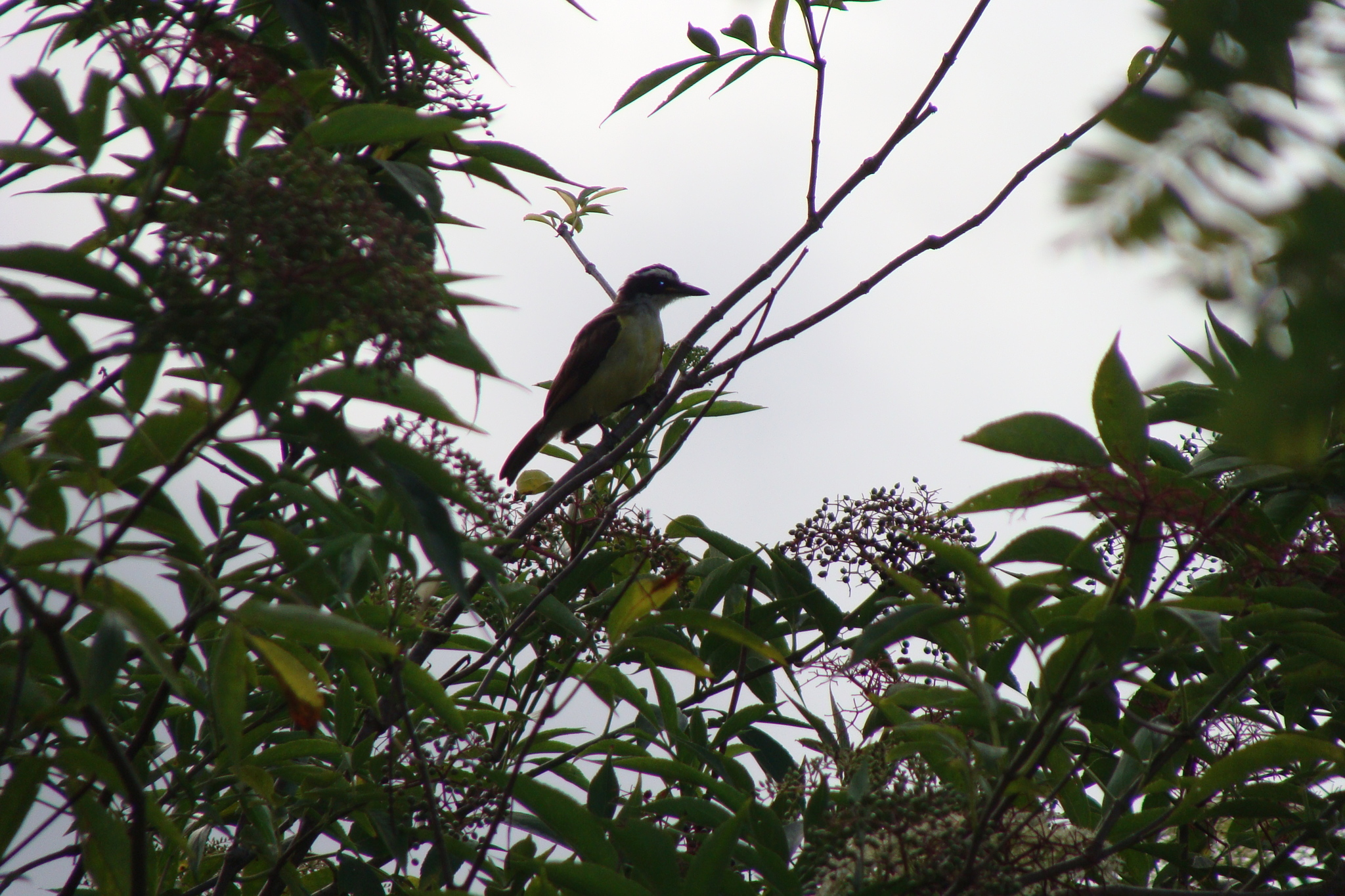
The great kiskadee (Pitangus sulphuratus) is a passerine bird in the tyrant flycatcher family Tyrannidae. It is the only member of the genus Pitangus. It breeds in open woodland with some tall trees, including cultivation and around human habitation. It is found from the extreme southern United States south to Argentina. It was introduced to Bermuda in 1957, and to Tobago in about 1970.
Taxonomy
The great kiskadee was described and illustrated in 1648 by the German naturalist Georg Marcgrave in the Historia Naturalis Brasiliae. He used the name Pitangua-guaçu, the word for a large flycatcher in the Tupi language. In 1760 the French zoologist Mathurin Jacques Brisson included a description of the species in his Ornithologie based on a specimen collected in Cayenne, French Guiana. He used the French name La Pie-Griesche jaune de Cayenne and the Latin name Lanius Cayanensis Luteus. Although Brisson coined Latin names, these do not conform to the binomial system and are not recognised by the International Commission on Zoological Nomenclature.
When the Swedish naturalist Carl Linnaeus updated his Systema Naturae for the twelfth edition in 1766 he added 240 species that had been previously described by Brisson in his Ornithologie. One of these was the great kiskadee. Linnaeus included a terse description, coined the binomial name Lanius sulphuratus, and cited Brisson's work. The specific name sulphuratus is Latin for 'sulphur'. The word had been used by Brisson in describing the yellow colour of the underparts of the bird.
The great kiskadee is now the only species placed in the genus Pitangus that was introduced by the English naturalist William Swainson in 1827. The lesser kiskadee was at one time also placed in Pitangus but in 1984 the American ornithologist Wesley E. Lanyon moved the lesser kiskadee to its own monotypic genus Philohydor. This has been accepted by some ornithologists, but not all. The bird was formerly also known as the Derby flycatcher....