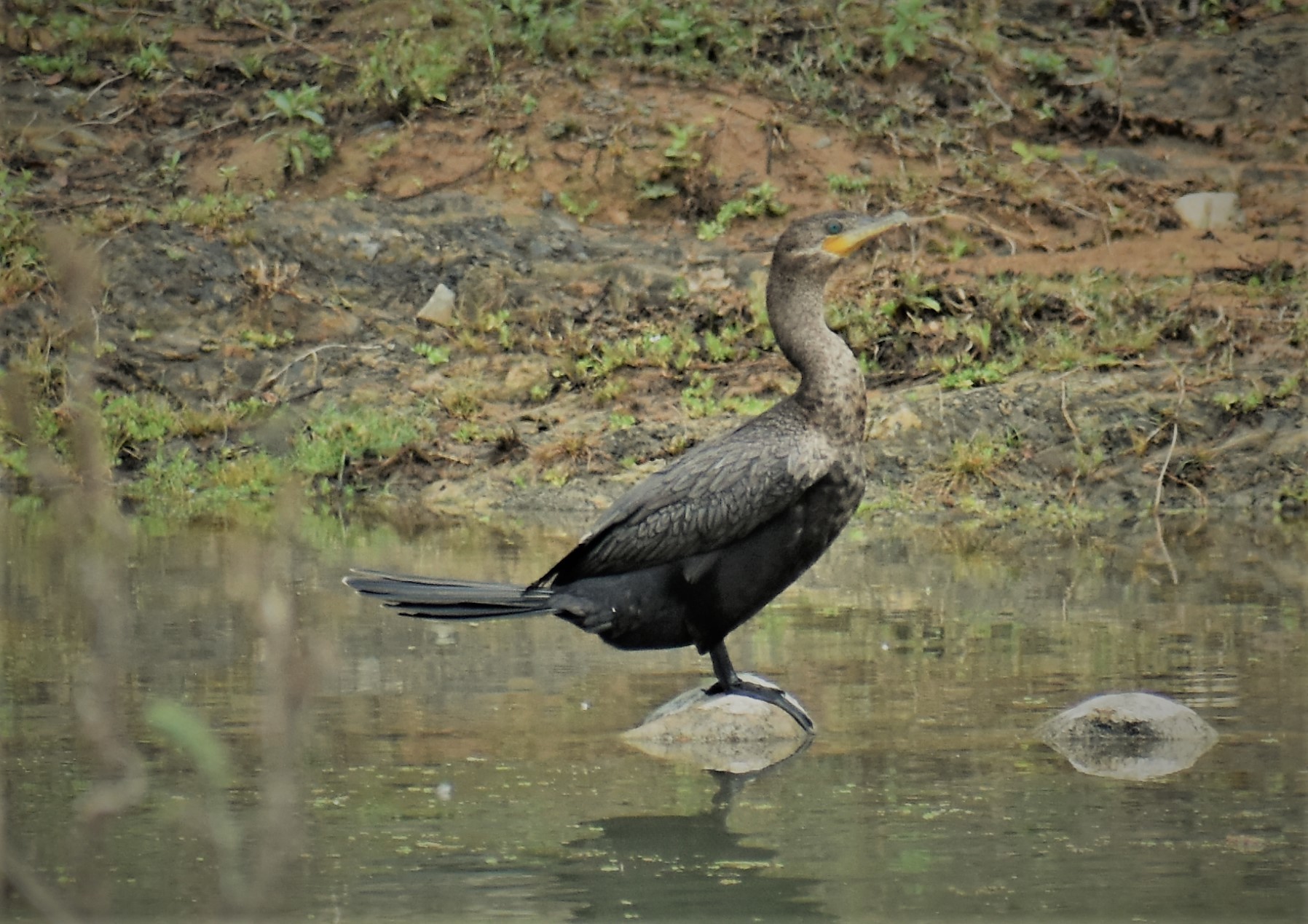
The neotropic cormorant or olivaceous cormorant (Nannopterum brasilianum) is a medium-sized cormorant found throughout the American tropics and subtropics, from the middle Rio Grande and the Gulf and Californian coasts of the United States south through Mexico and Central America to southern South America, where it is called by the indigenous name of biguá. It also breeds in the Bahamas, Cuba, and Trinidad. It can be found both on coasts (including some mangrove areas) and in inland waters. There are at least two subspecies: N. b. mexicanum from Nicaragua northwards and N. b. brasilianum further south. In Peru, the neotropic cormorant is used by the Uru people for fishing.
Taxonomy
The neotropic cormorant was documented in 1658 by the Dutch naturalist Willem Piso after travels in Brazil. This formed the basis for the formal description and naming of the species by Johann Friedrich Gmelin in 1789. He placed it with the petrels in the genus Procellaria and coined the binomial name Procellaria brasiliana. Many authors preferred to use Alexander von Humboldt's 1805 description of Pelecanus olivaceus because the identity of Piso's birds was considered uncertain. Later, ornithological authorities such as the American Ornithologists' Union began to use Phalacrocorax brasilianus after Ralph Browning argued that Piso's description and paintings do indeed refer to the neotropic cormorant.
The neotropic cormorant was formerly placed in the genus Phalacrocorax. A molecular phylogenetic study of the cormorants published in 2014 found that the neotropic cormorant, the double-crested cormorant, and the flightless cormorant formed a clade that was sister to the genus Leucocarbo. The three species were, therefore, moved to the resurrected genus Nannopterum that had been introduced in 1899 by English ornithologist Richard Bowdler Sharpe to accommodate the flightless cormorant. The genus name Nannopterum combines the Ancient Greek nannos meaning "dwarf" with pteron meaning "wing"....