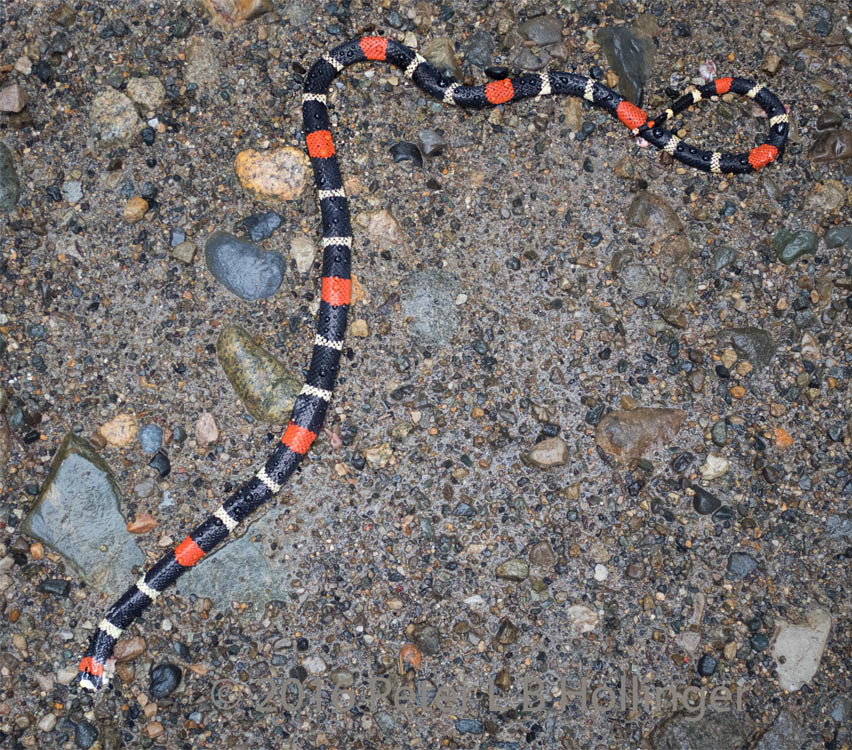
Micrurus lemniscatus, commonly known as the South American coral snake, is a species of venomous snake in the family Elapidae. The species is endemic to South America.
Description
Micrurus lemniscatus is a thin and brightly colored species. Adults usually have a total length (tail included) of 60–90 cm (24–35 in), but the maximum reported total length is 145 cm (57 in). The snout is black, followed by a narrow white crossband in front of the eyes, then a wider black band including the eyes. The eyes are small, and the rest of the head is red. The body pattern consists of slightly broad red rings that are separated by seven to 17 triads of three black and two white rings. The tail has two triads.
Behavior
Like many coral snakes, Micrurus lemniscatus is nocturnal and terrestrial, digging in loose soil or litter. It is not aggressive towards humans, although it can attack to defend itself.
Reproduction
Breeding of Micrurus lemniscatus is oviparous, having a clutch size of possibly 20 eggs.
Diet
Alimentation of Micrurus lemniscatus is mainly long-bodied vertebrates such as freshwater eels, gymnotiform fishes, caecilians, lizards, and snakes.
Geographic range
Micrurus lemniscatus is found in Argentina, northern Bolivia, Brazil, Colombia, eastern Ecuador, French Guiana, Guyana, Paraguay, eastern Peru, Suriname, Trinidad, and Venezuela.
Habitat
Micrurus lemniscatus is a widespread species in South America, living in humid forests and lowland forests, in open savannas and gallery forests. It is also found in lowland floodplains, deforested areas or near human habitation, in humid areas or near places with a water source. It occurs from near sea level to an altitude of 1,000 m (3,300 ft).
Venom
The venom of Micrurus lemniscatus is a potent post- and pre-synaptic neurotoxin, which causes a potent and irreversible neuromuscular block in vertebrates. Lemnitoxin, a potent myotoxic PLA2 type toxin, isolated from the venom of M. lemniscatus induces local and systemic...