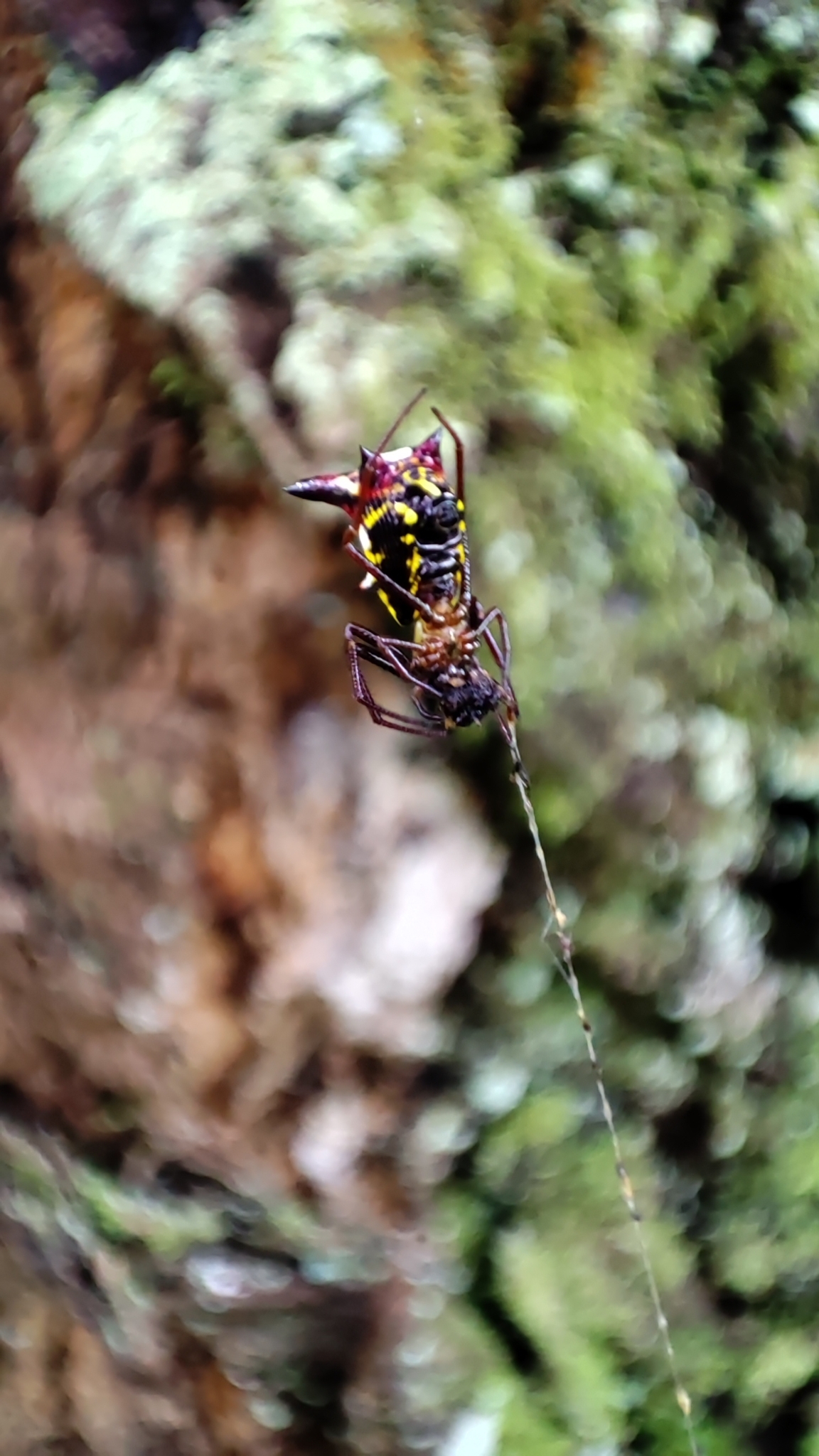
Micrathena, known as spiny orbweavers, is a genus of orb-weaver spiders first described by Carl Jakob Sundevall in 1833. Micrathena contains more than a hundred species, most of them Neotropical woodland-dwelling species. The name is derived from the Greek "micro", meaning "small", and the goddess Athena.
Species with extremely long spines evolved at least eight times in the genus Micrathena and likely function as anti-predator defenses. Gasteracantha orb-weavers also have hardened abdomens with variously shaped spines, but they are not closely related to Micrathena within the orb-weaver family.
These spiders are active during the daytime and build vertical orb webs. Unlike many other orb-weavers, members of Micrathena bite their prey before wrapping it. When laying eggs, females will place the egg sac on vegetation near the web.
Species
As of April 2019 the genus Micrathena contains 119 species:
Micrathena mitrata in Alabama, USA
Micrathena sexpinosa in Panama
Micrathena vigorsi from Colombia to Brazil
Micrathena gracilis in Virginia, USA
M. abrahami (Mello-Leitão, 1948) – Colombia to Brazil
M. acuta (Walckenaer, 1841) – Trinidad to Argentina
M. agriliformis (Taczanowski, 1879) – Costa Rica to Bolivia
M. alvarengai Levi, 1985 – Brazil
M. anchicaya Levi, 1985 – Colombia, Ecuador
M. annulata Reimoser, 1917 – Colombia, Brazil, Paraguay, Argentina
M. armigera (C. L. Koch, 1837) – Brazil, Peru, Guyana
M. atuncela Levi, 1985 – Colombia
M. aureola (C. L. Koch, 1836) – Colombia to Suriname, Paraguay
M. balzapamba Levi, 1985 – Ecuador
M. bananal Levi, 1985 – Brazil
M. bandeirante (Magalhaes & Santos, 2011) – Brazil, Argentina
M. banksi Levi, 1985 – Cuba
M. beta Caporiacco, 1947 – Guyana, French Guiana, Brazil, Ecuador, Peru
M. bicolor (Keyserling, 1864) – Colombia, Peru
M. bifida (Taczanowski, 1879) – Peru
M. bimucronata (O. Pickard-Cambridge, 1899) – Mexico to Panama
M. bogota Levi, 1985 – Colombia
M. brevipes (O....