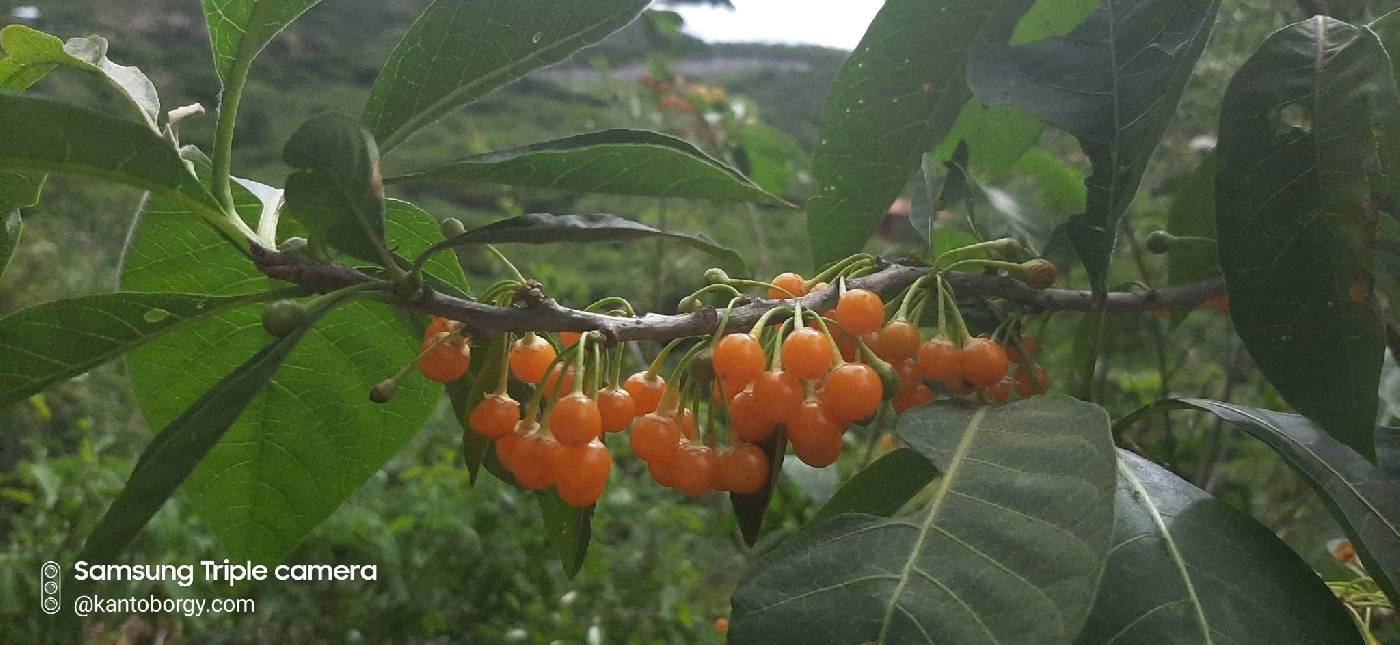
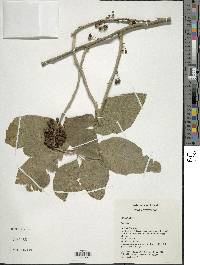
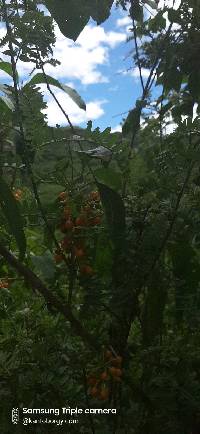
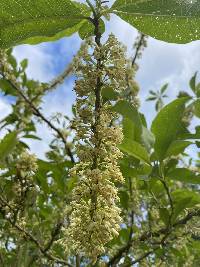
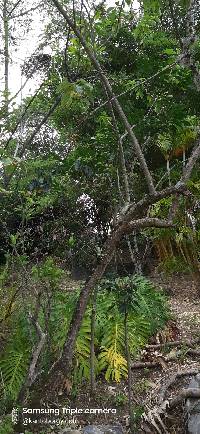
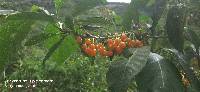
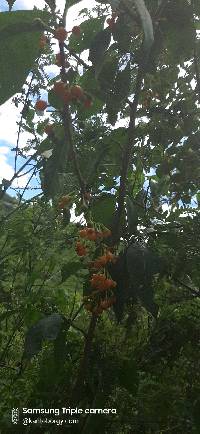
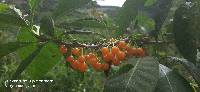
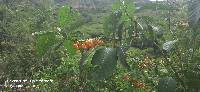
Iochroma arborescens is a species of flowering plant in the genus Iochroma, belonging to the nightshade family Solanaceae. Formerly it was considered the single species in the monotypic genus Acnistus. Common names include gallinero (= 'henhouse'), mata-gallina (= 'chicken-killer'), fruta-de-sabiá (= 'thrush-fruit'), hollowheart, wild tobacco, siyou, bastard sirio, galán arbóreo, tabaco de monte (= 'mountain tobacco'), nigüito, marieneira, güitite, and tabak djab (= 'devil's tobacco').
Etymology
The former genus name Acnistus has been claimed to be a compound of the Greek prefix 'a-' and Latin 'cnistus' which would give the meaning 'without a crest'. A more likely derivation, however, is from the single Homeric Greek word άκνηστις (pron. 'akneestis' / 'aknistis'), meaning 'backbone', possibly in reference to the backbone-like, white, longitudinal stripes running up the centre of each green patch on the exterior of the corolla.
Publication
The genus name Acnistus was published by Austrian botanist Heinrich Wilhelm Schott in Wiener Zeitschrift für Kunst, Litteratur, Theater und Mode, (- abbreviation :'Wiener Z. Kunst' - a journal featuring botanical descriptions and illustrations published between the years 1817 and 1848 ) : Vol. 4: 1180 on the 28th of November of the year 1829.
The binomial Acnistus arborescens (L.) Schltdl. was published by German botanist Diederich Franz Leonhard von Schlechtendal in the journal Linnaea, Vol. 7 (pps. 67–68) in the year 1832.
History of classification
Dunalia spinosa, wild plant, growing near the town of Chachas in southern Peru (The plant now known as Acnistus arborescens has, in the past, been assigned to the closely related genus Dunalia – among many other genera.)
The case of Acnistus arborescens is remarkable, considering the vicissitudes of its long and varied taxonomic history; it has received 29 botanical names with 17 different epithets associated to 6 generic names.- Armando Hunziker