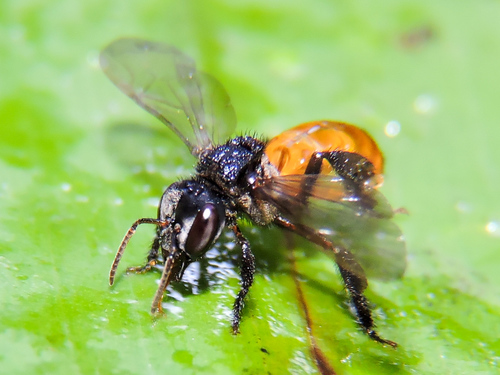
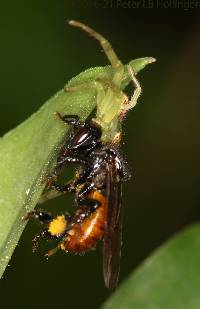
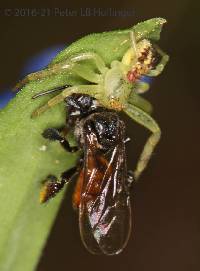
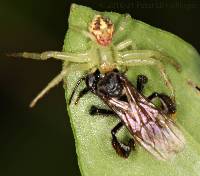
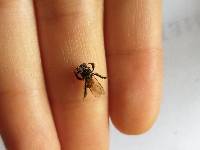
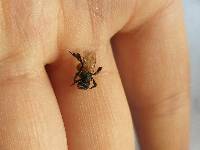
Trigona fulviventris, known by the common names culo-de-vaca, culo-de-señora, mu'ul-kab, culo-de-buey, and culo-de-vieja, is a species of stingless bee found in Mexico and neotropical regions of Central and South America. It is one of the largest and most widespread bees of its genus. They exhibit complex foraging behaviors by integrating spatio-temporal learning and flower scents. T. fulviventris has traditionally been observed to abstain from aggressive behavior with other species; however, more recent analyses have shown that T. fulviventris emit pheromones that act as attack signals particularly when related individuals are captured by predators.
Taxonomy and phylogeny
Trigona fulviventris was first described by Félix Édouard Guérin-Méneville in 1845. It is a member of the order Hymenoptera, which includes ants, bees, wasps, and sawflies and part of the family Apidae, which includes other bees such as bumble bees, honey bees, and orchid bees. It is further categorized in the genus Trigona, a genus of stingless bees.
Two subspecies of T. fulviventris have been identified: T. f. fulviventris and T. f. guianae. These subspecies are distinguished by coloration; morphological studies have shown that the subspecies cannot be easily separated by strictly morphological analyses.
Description and identification
Trigona fulviventris individuals are morphologically characterized by the expression of two projections, called tubercles on their labra as well as the presence of four mandibular teeth. The two identified subspecies of T. fulviventris, T. f. fulviventris and T. f. guianae, can be distinguished by differences in metasomal coloration. T. f. fulviventris metasoma are rust-colored with some differences in tone between individuals, while T. f. guianae metasoma and the rest of the body are black, sometimes expressing some reddish tones. T. fulviventris individuals are among the largest of their genus, ranging in size from 5 to 6.5 millimeters in length.