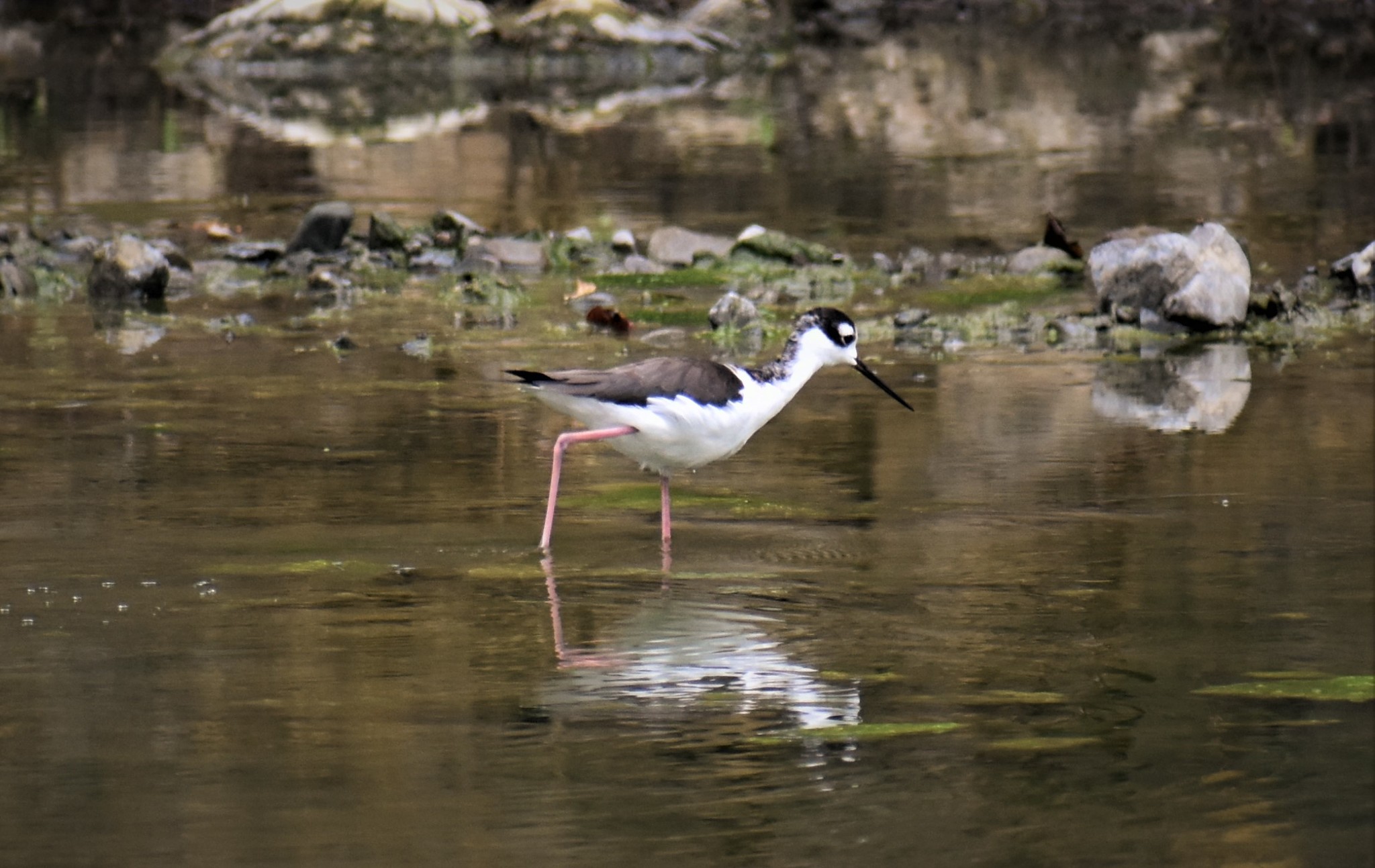
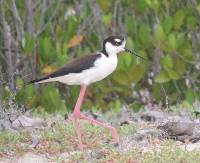
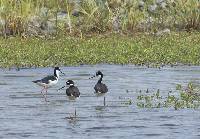
The black-necked stilt (Himantopus mexicanus), also called the pied stilt, is a locally abundant shorebird of North and South American wetlands and coastlines. It is found from the coastal areas of California through much of the interior western United States and along the Gulf of Mexico as far east as Florida, then south through Central America and the Caribbean to Brazil, Peru and the Galápagos Islands, with an isolated population, the Hawaiian stilt, in Hawaii. The northernmost populations, particularly those from inland, are migratory, wintering from the extreme south of the United States to southern Mexico, rarely as far south as Costa Rica; on the Baja California peninsula it is only found regularly in winter. Some authorities, including the IUCN, treat it as a synonym of Himantopus himantopus.
Taxonomy
The black-necked stilt was formally described in 1776 as Charadrius mexicanus by the German zoologist Philipp Statius Müller. The species is now placed in the genus Himantopus that was introduced in 1760 by the French ornithologist Mathurin Jacques Brisson.
Three subspecies are recognised:
H. m. knudseni Stejneger, LH, 1887 – main Hawaiian Islands
H. m. mexicanus (Müller, PLS, 1776) – breeds inland south-central Canada (sporadic) locally eastward through south-central US and southward to southwestern coastal Peru and Galápagos; also coastal Venezuela to northeastern Brazil and throughout West Indies; winters inland central California, coastal Gulf of Mexico and Florida southward
H. m. melanurus Vieillot, LJP, 1817 – inland central Peru and Bolivia and southeastern Brazil to southcentral Chile and Argentina
The subspecies H. m. melanurus has sometimes been considered as a separate species, the white-backed stilt.
The black-necked stilt has often been treated as a subspecies of the common or black-winged stilt, using the trinomial name Himantopus himantopus mexicanus. However, the AOS has always considered it a species in its own...