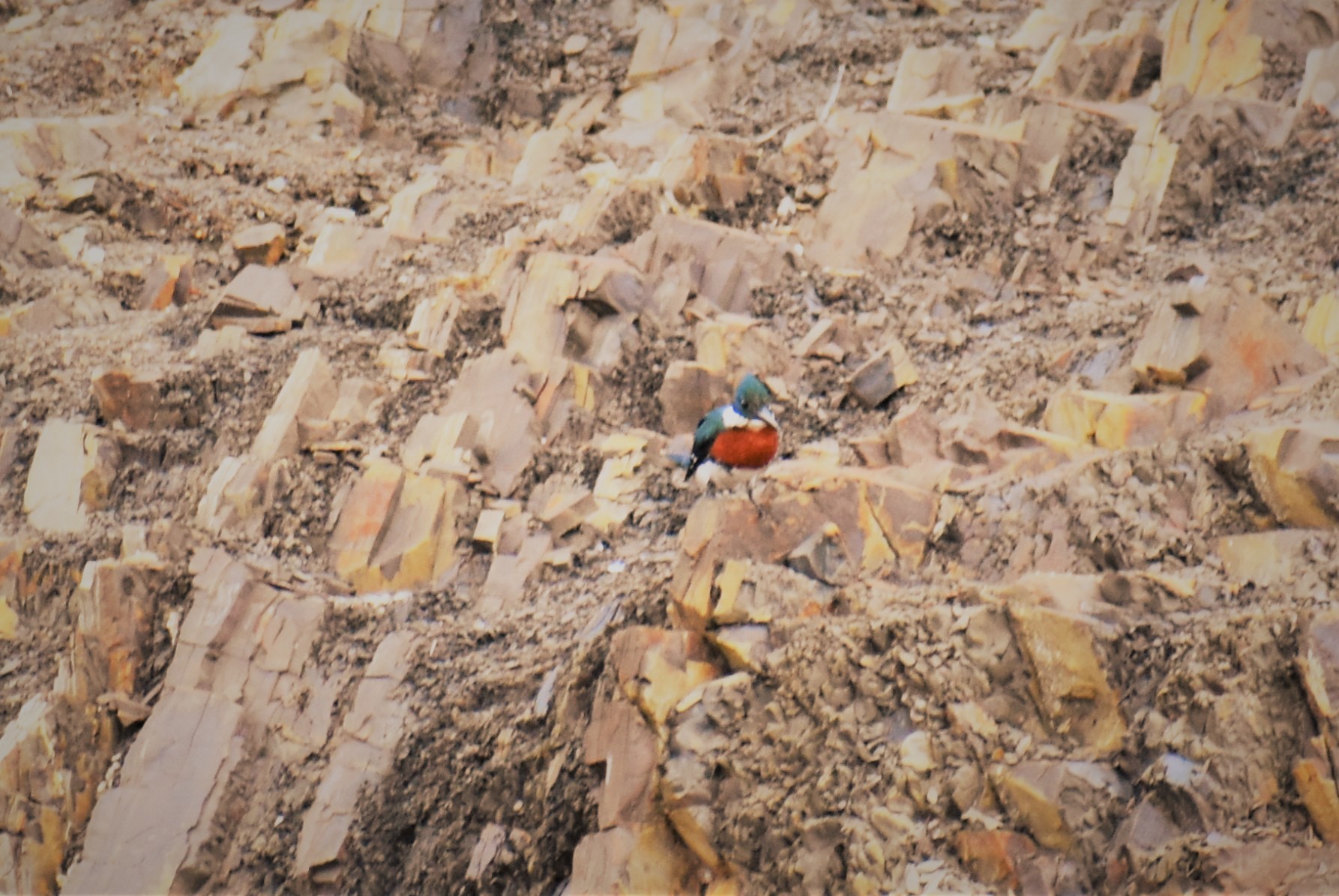
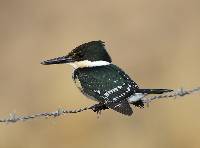
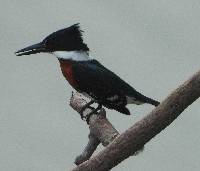
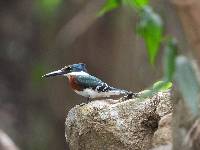
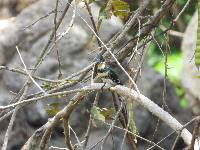
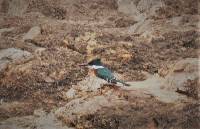
The green kingfisher (Chloroceryle americana) is a species of "water kingfisher" in the subfamily Cerylinae of the family Alcedinidae. It is found from southern Texas in the United States south through Central America, and in every mainland South American country except Chile.
Taxonomy and systematics
The green kingfisher was formally described in 1788 by the German naturalist Johann Friedrich Gmelin in his revised and expanded edition of Carl Linnaeus's Systema Naturae. He placed it with the other kingfishers in the genus Alcedo and coined the binomial name Alcedo americana. Gmelin based his description on "Le martin-pêcheur vert et blanc" from Cayenne that had been described and illustrated in 1780 by the French polymath Comte de Buffon and also the "white and green kingfisher" that had been described in 1782 by the English ornithologist John Latham. The green kingfisher is now placed in the genus Chloroceryle that was introduced in 1848 by Johann Jakob Kaup.
A molecular phylogenetic study published in 2006 found that the green kingfisher is a sister species to the larger green-and-rufous kingfisher (C. inda).
Five subspecies are recognized:
Image
Subspecies
Distribution
C. a. hachisukai (Laubmann, 1941)
from extreme southern Arizona, southwestern New Mexico, and west central Texas in the US into northwestern Mexico to Nayarit
C. a. septentrionalis (Sharpe, 1892)
from south central Texas and eastern Mexico south to northern Colombia and western Venezuela
C. a. americana (Gmelin, JF, 1788)
South America east of the Andes from Venezuela east through the Guianas into northern and central Brazil and south to northeastern Bolivia; also Trinidad and Tobago
C. a. mathewsii Laubmann, 1927
from southern Brazil and southern Bolivia through Paraguay and Uruguay to central Argentina
C. a. cabanisii (Tschudi, 1846)
west of the Andes from Colombia through Ecuador to southernmost Peru; as a vagrant to Chile