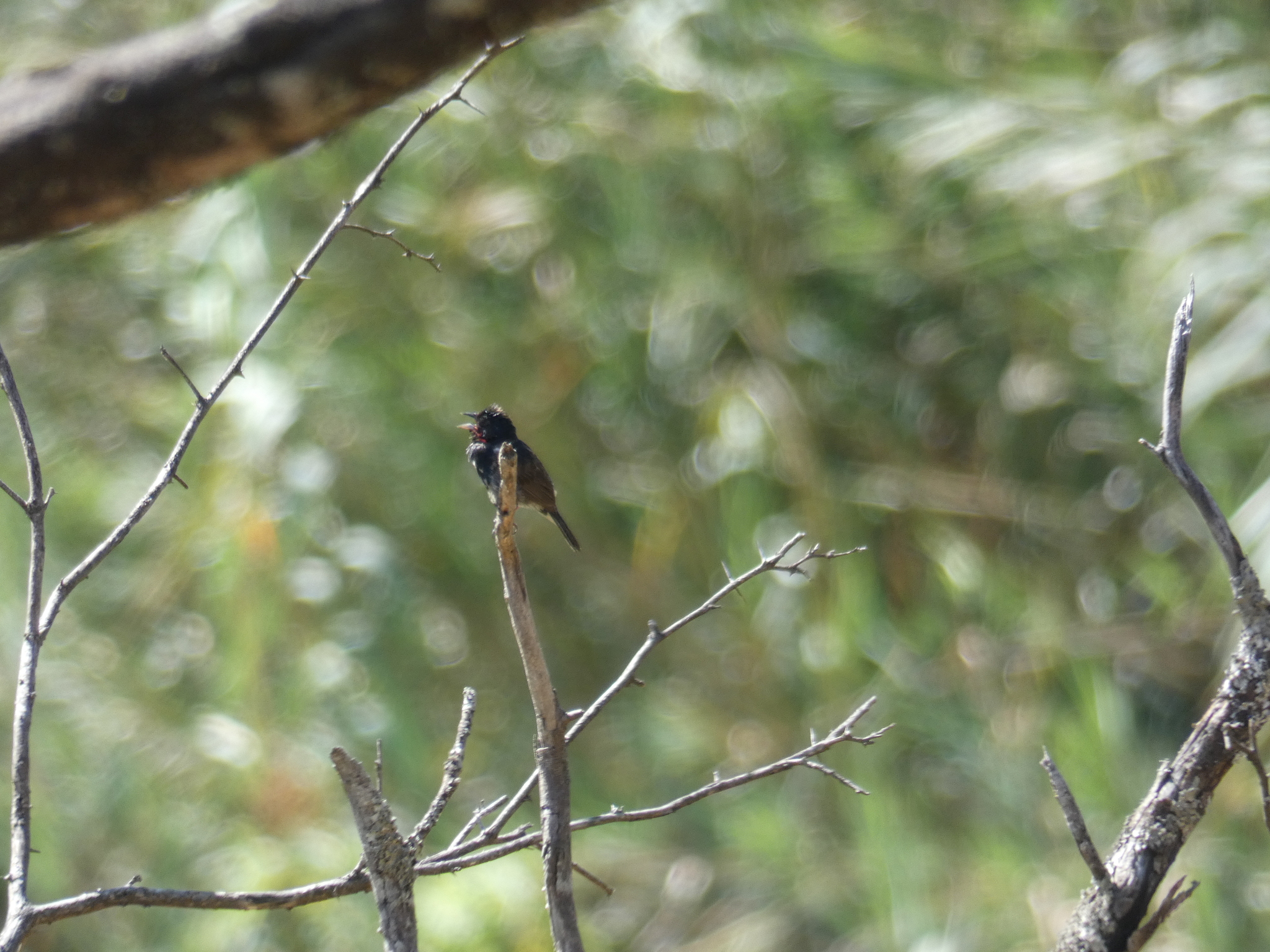
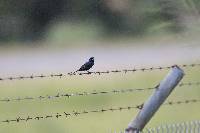
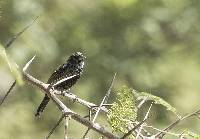
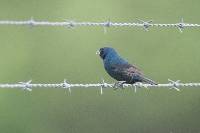
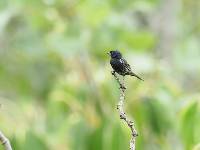
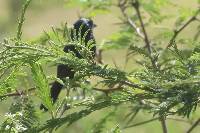
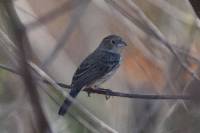
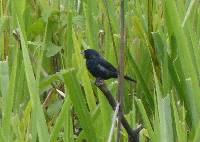
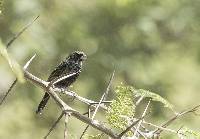
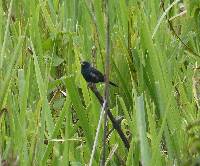
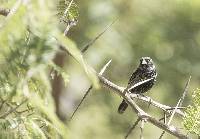
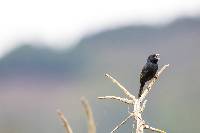
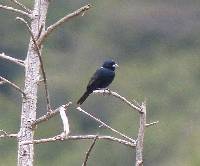
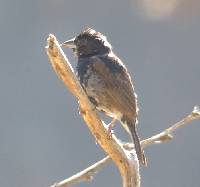
The blue-black grassquit (Volatinia jacarina) is a small Neotropical bird in the family Thraupidae, the tanagers and allies. It is found in Mexico, every Central American country, every mainland South American country, in Trinidad and Tobago, and in Grenada.
Taxonomy and systematics
The blue-black grassquit was formally described by the Swedish naturalist Carl Linnaeus in 1766 in the twelfth edition of his Systema Naturae under the binomial name Tanagra jacarina. Linnaeus based his description on the "Jacarni" that was described in 1648 by the German naturalist Georg Marcgrave in his Historia Naturalis Brasiliae. The type locality is eastern Brazil. The specific epithet jacarina is derived from the Tupi language and was used for a type of finch. The blue-black grassquit is now the only species in the genus Volatinia that was introduced in 1850 by the German naturalist Ludwig Reichenbach. The genus name is a diminutive of the Latin volatus meaning "flying".
Within the tanager family Thraupidae the blue-black grassquit is in the subfamily Tachyphoninae and is a member of a clade that contains the genera Conothraupis and Creurgops. It was formerly placed with the buntings in the subfamily Emberizinae rather than with the tanagers in Thraupinae within an expanded family Emberizidae.
The blue-black grassquit has these three subspecies:
V. j. splendens (Vieillot, 1817)
V. j. jacarina (Linnaeus, 1766)
V. j. peruviensis (Peale, 1849)
Description
The blue-black grassquit is 8.7 to 10.9 cm (3.4 to 4.3 in) long and weighs 8 to 12 g (0.28 to 0.42 oz). It has a longish conical bill. The species is sexually dimorphic. Adult males of the nominate subspecies V. j. jacarina are mostly black with dark blue iridescence. Their flight feathers and tail are flat black. Their axillaries, underwing coverts, and the bases of the remiges' underside have a white patch that usually is visible only in flight. Adult females have a warm brown head and upperparts with faint darker...