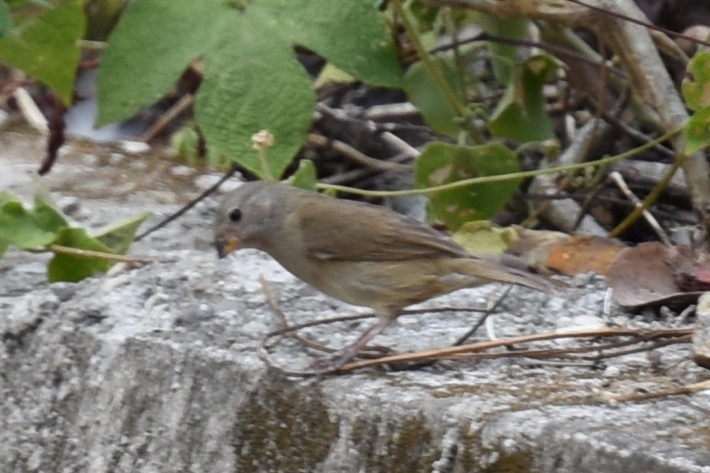
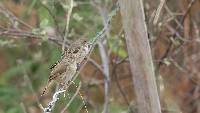
The dull-colored grassquit (Asemospiza obscura) is a small bird in the family Thraupidae, the tanagers and allies. It is found in Argentina, Bolivia, Brazil, Colombia, Ecuador, Paraguay, Peru and Venezuela.
Taxonomy and systematics
The dull-colored grassquit was formally described in 1837 with the binomial Emberiza obscura. For much of the twentieth century it was placed in the genus Sporophila but by the early twenty-first it had been transferred to Tiaris. Finally, based on studies published in 2014 and 2015, in 2016 Burns et al. erected the genus Asemospiza with the sooty grassquit (A. fuliginosa) as the type species and including the dull-colored grassquit. The genus is closely related to Darwin's finches.
The dull-colored grassquit has these four subspecies:
A. o. haplochroma (Todd, 1912)
A. o. pauper (Berlepsch & Taczanowski, 1884)
A. o. obscura (d'Orbigny & Lafresnaye, 1837)
A. o. pacifica (Koepcke, 1963)
Description
The dull-colored grassquit is 10.5 to 11.5 cm (4.1 to 4.5 in) long and weighs an average of 11.2 g (0.40 oz). The sexes have the same plumage. Adults of the nominate subspecies A. o. obscura have a brownish head and upperparts. They have thin, pale supercilium, a darker line through the eye, and pale crescents above and below the eye. Their throat, breast, and upper flanks are grayish brown and their belly paler. Its more northerly population has a darker breast than more southerly birds. They have a dark brown iris, a dark bill with a yellowish horn base to the mandible, and brownish legs.
Subspecies A. o. haplochroma is the darkest of the four. It is essentially all brownish with little contrast between the upper- and underparts. It alone has an entirely dark bill. The population of A. o. pauper in Colombia and Ecuador has a pale brown breast, buffy flanks, and a pale cream belly; its bill has a dark maxilla and a pale mandible. In the south its breast is grayish and both its flanks and belly pale cream. A. o. pacifica is large...