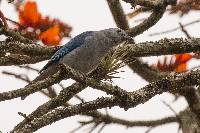
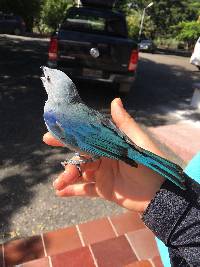
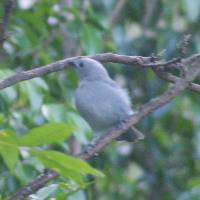
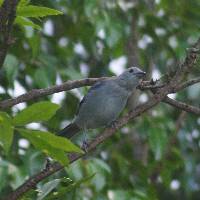
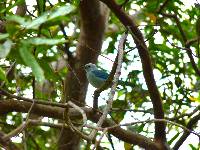
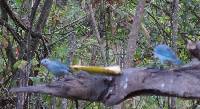
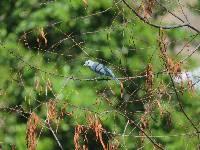
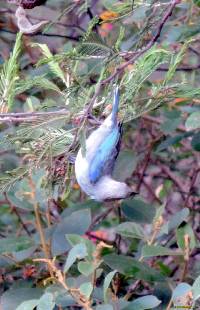
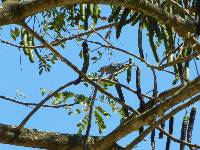
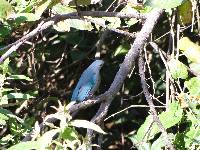
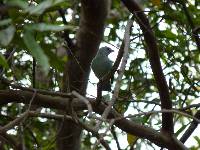
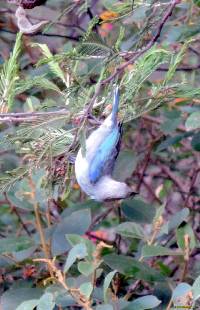
The blue-gray tanager (Thraupis episcopus) is a medium-sized South American songbird of the tanager family, Thraupidae. Its range is from Mexico south to northeast Bolivia and northern Brazil, all of the Amazon Basin, except the very south. It has been introduced to Lima (Peru) and Florida (United States). On Trinidad and Tobago, this bird is called blue jean.
Taxonomy
In 1760 the French zoologist Mathurin Jacques Brisson included a description of the blue-gray tanager in his Ornithologie based on a specimen collected in Brazil. He used the French name L'evesque and the Latin name Episcopus avis. Although Brisson coined Latin names, these do not conform to the binomial system and are not recognized by the International Commission on Zoological Nomenclature. When in 1766 the Swedish naturalist Carl Linnaeus updated his Systema Naturae for the twelfth edition, he added 240 species that had been previously described by Brisson in his Ornithologie. One of these was the blue-gray tanager. Linnaeus included a terse description, coined the binomial name Tanagra episcopus, and cited Brisson's work. The specific name episcopus is Latin for "bishop". It was placed in the genus Thraupis by the German naturalist Friedrich Boie in 1826. It was placed back in the genus Tangara (bird) in 2016.
There are 14 recognized subspecies, differing according to the exact hue of blue of the shoulder patch versus the rest of the plumage; they may be grayish, greenish, or purplish-blue, with a lavender, dark blue, or whitish shoulder patch. For example, T. e. berlepschi (endemic to Tobago) is a brighter and darker blue on the rump and shoulder; T. e. neosophilus with a violet shoulder patch occurs in northern Venezuela, Trinidad, eastern Colombia, and the far north of Brazil; T. e. mediana of the southern Amazon basin has a white wing patch; and T. e. cana in the northern Amazon has blue shoulders.