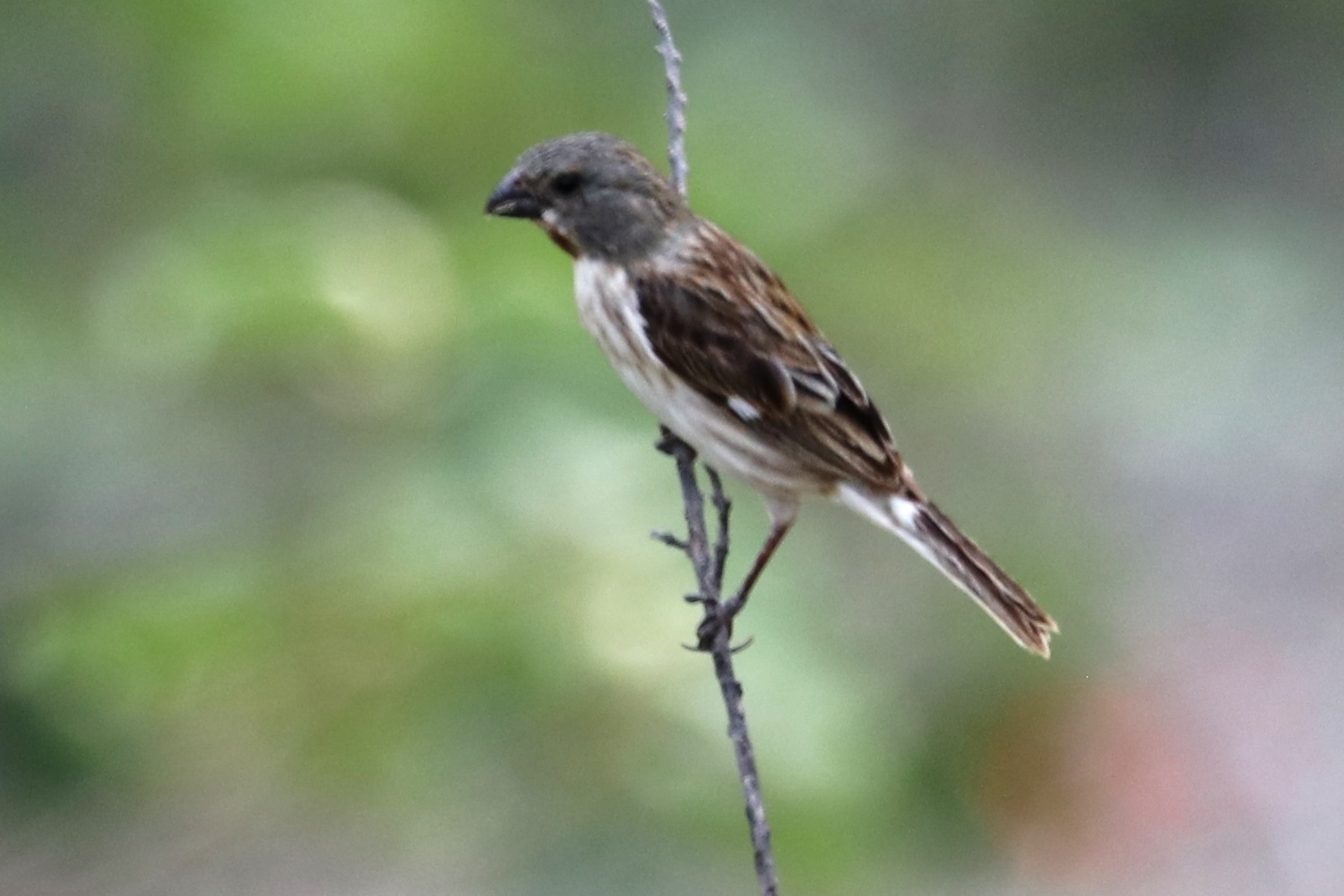
The chestnut-throated seedeater (Sporophila telasco) is a Neotropical songbird in the family Thraupidae, the tanagers and allies. It is found in Chile, Colombia, Ecuador, and Peru.
Taxonomy and systematics
The chestnut-throated seedeater has a somewhat complicated taxonomic history. It was formally described in 1828 with the binomial Pyrrhula telasco. For a time it bore the binomial Spermophila telasco but by 1938 had been reassigned to its present genus Sporophila. Sporophila was a genus in the family Emberizidae. Based on studies published between 1988 and 2011, beginning in 2012 Sporophila was moved to the tanager family Thraupidae.
What had been called the Tumaco seedeater (S. insulata) (Chapman, 1921) was later proven to be genetically indistinguishable from the chestnut-throated despite having more chestnut on its underparts. It was therefore merged into the chestnut-throated as a color morph.
The chestnut-throated seedeater is monotypic.
Description
The chestnut-throated seedeater is 10 to 10.5 cm (3.9 to 4.1 in) long; two males weighed 8.4 and 10.9 g (0.30 and 0.38 oz). It has a short, thick bill with a rounded culmen. The species is sexually dimorphic. Adult males have a medium gray head with deep chestnut bases on the crown feathers that show as the feathers wear. Their upperparts are mostly grayish with a slightly browner hindneck and lower back and dusky streaks on the crown and mantle. Their rump is white and their uppertail coverts gray. Their tail is mostly blackish with grayish feather edges and a small amount of white on the feathers' bases. Their wings are blackish with grayish edges on the coverts and tertials that sometimes show as two faint wing bars. The wings have white bases on the primaries that show as a patch on the closed wing. Their throat and upper breast are dark chestnut with tiny white spots at the base of the bill and the rest of their underparts are whitish. "Tumaco" seedeaters have mostly chestnut underparts with a whitish...